Baile an Tí Mhóir – Baltimore. The name is Irish – some folks don’t know that the Calvert family lived in County Longford, Ireland. Baltimore is simply the Anglicization of Gaelic/Irish. It means – town of the big house. So if anyone ever tries to tell you that Baltimore is English? Yeah. That’d be a no.
On land that had been hunting grounds for the Susquehanock tribe, a port was created in 1706 at what is now Locust Point (the Fort McHenry area) for the sole purpose of tobacco trade and wheat trade to England. Baltimore Town sprang up in 1729; Jones Town in 1732 (thanks to some folks who thought to create a rival town to the east); and Fells Point in 1733. They were separate towns until 1745 when Baltimore Town and Jones Town merged thanks to the Gay Street Bridge that joined them. By 1752 there were twenty-seven homes, a church and two taverns. Fells Point didn’t become part of the city until 1773, having been engaged in a bitter feud over ship-building until then. The original “town” occupied the area of Holliday/Commerce Street to the east, Saratoga Street to the north , and Liberty/Cathedral Streets to the west.
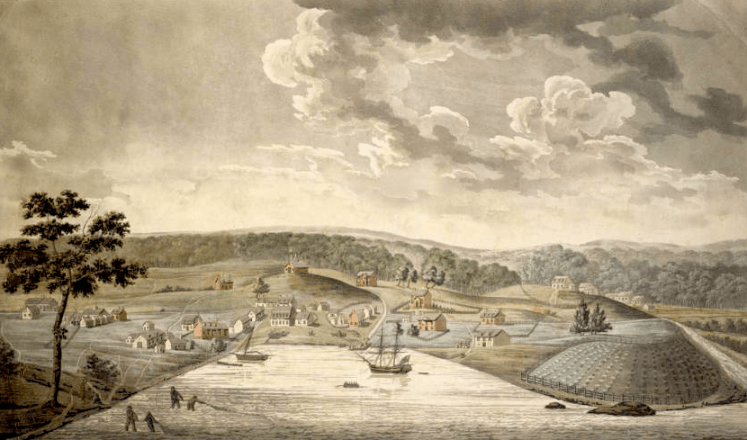
Baltimore in 1752 – Wikipedia
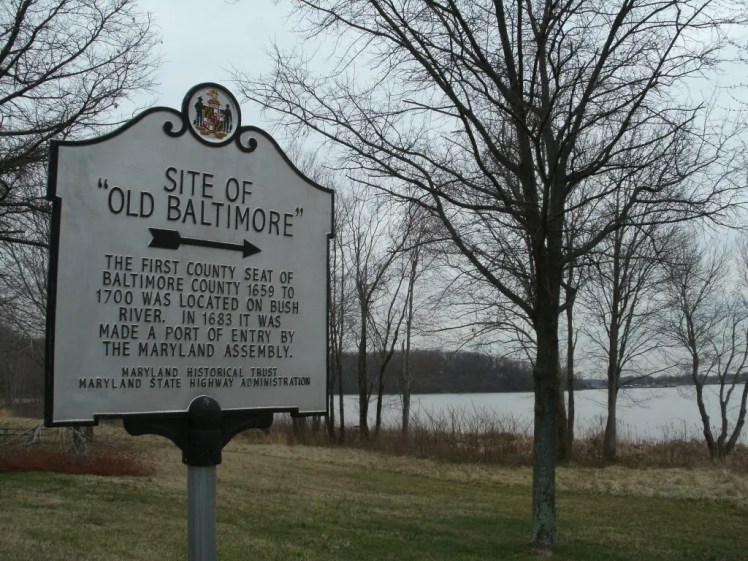
The Maryland Assembly had actually tried to erect two previous towns named Baltimore – one on the Eastern Shore and one in what is present Harford County. The first incarnation was located at the present site of Chilbury Point in Aberdeen Proving Grounds as the county seat of Baltimore County (which included at the time – Harford and Cecil County.) Estabished in 1659 – by 1674 a courthouse was being built and most the land itself was owned by William Osbourne. By 1680 it was a prosperous tobacco port with a ferry landing. Despite being made a Port of Entry in 1683, by 1691 the county seat had shifted and by 1699 Baltimore Town had failed and was abandoned due to the silting in the Bush River. As a result, the port shifted and the third incarnation finally stuck.
For 40 schillings an acre, the Assembly’s Commissioners bought 60 acres from the Carroll family. The site was chosen because of the harbor, the road to Philadelphia nearby and the Jones Falls. Named for David Jones, a settler who had built a home on the eastern shore of the river in 1661, it provided an endless supply of water power, which in turn would keep mill wheels turning.
Baltimore served as a granary for the sugar producing plantations on Jamacia, St. Michaels, St. Johns, Barbados and the Virgin Islands in the 18th century. Ironically, Domino Sugar has been operating in Baltimore for over 90 years and is owned by American Sugar Refining Company – founded in 1779 by William Frederick Havemeyer. Baltimore is also home to Lexington Market, established in 1782 as part of the public market system (est 1763). The market is one of the oldest operating public markets in the US and was the center of Baltimore’s slave trade prior to the Civil War.
Baltimore Town, Jones Town and Fells Point were finally incorporated in the city of Baltimore in 1796 and remained the county seat until 1851 when it’s population increase changed its status to that of independent city.
Sources:
https://patch.com/maryland/aberdeen/sign-site-of-old-baltimore
 Baltimore Through My Eyes