The American Revolution left Baltimore relatively untouched. The city built ships for America’s young navy and boasted statesmen like Charles Carroll of Carrollton and military minds like Col. John Eager Howard. The ironworks at Ridgley’s Hampton estate produced cannon and ammunition for the Continental Army. Following the war, the city grew and by 1800, the census has the population at 31,500 people- doubling the number on the census in 1790.

“The Basin” in Fells Point – Wikipedia
When the War of 1812 began, Fells Point became a target because of it’s ship building prowess. The original USS Constellation was built in Canton 1797 and the city’s pride and joy was it’s topsail schooners. They were used as blockade runners because of their agility and speed, and by the War of 1812 they were manned by privateers who harassed the British Navy all the way to the shores of England with their daring raids. Nicknamed “Baltimore Clippers”, these ships are the reason the British vowed to wipe out the “nest of pirates” on the Chesapeake. Between 1810 and 1815, the shipyards in Fells Point literally cranked out over 150 schooners. The Pride of Baltimore II – a topsail schooner built in 1988 to replace the original Pride of Baltimore – (lost at sea in 1986) – is based directly in the design of the Chasseur, Baltimore’s most successful privateer ship, built in 1812 at Brown’s Wharf, and given the nickname Pride of Baltimore.
On September 12,1814, British troops commanded by General Robert Ross landed in North Point and began their march on Baltimore. The were met by the City Brigade under Gen. John Stricker and in the ensuing exchange of gunfire, General Ross was killed by snipers and the British troops eventually withdrew after the coordinated retreat by American troops. The next day, they tried to attack Baltimore by sea, but were unable to penetrate Fort McHenry which sat at the mouth of the harbor. The bombardment lasted all day and into the night, and Francis Scott Key, a lawyer, who was aboard a British vessel negotiating for the release of a prisoner, saw that Mary Pickersgill’s positively enormous flag “was still there.”
Commissioned by General Armistead the previous year to make a flag large enough so that the British could see it at a great distance, the 30 x 42 foot flag had survived the bombardment and the Fort had not surrendered. In fact the fort had not even returned fire. The British ships sat in the harbor, out of range of the fort’s cannon – their goal being to coordinate with a land force. The Battle of North Point had squelched that, and coordinating anything else from that distance was impossible, so the British called off the attack. By December the Treaty of Ghent was being drawn up, by February it was ratified. The war was over.

The flag – it was made with the blue canton resting on a red stripe. This was a “war” or “blood” stripe.
Mary Young Pickersgill
Born in 1776 in Philadelphia, Mary was the daughter of William and Rebecca Young. Her mother was a flag maker during the Revolutionary War. Widowed at age 29, Mary moved to Baltimore and opened her own flag shop. When Armistead hired her in 1813, he actually paid her $574.44 for two flags. That’s $11303.78 today. The first was a storm flag, which was to be 15 by 24 feet, and garrison flag which was the 30 by 42 foot one. Because the task was so daunting and she had just 6 weeks to complete it, she engaged the services of her daughter Caroline, her mother, 2 of her nieces and 13 year old Grace Wisher, a free girl of color who was apprenticed to Mary and lived in her home. There was another free woman of color who stitched the flag as well, but her name had been lost to history. The flag was so large and heavy, weighing in at about 50 pounds, Mary had to get permission from the owners of a nearby brewery to use the floor of their malt house to work on the woolen flag. It took 9 men to hoist it up the flagpole.
us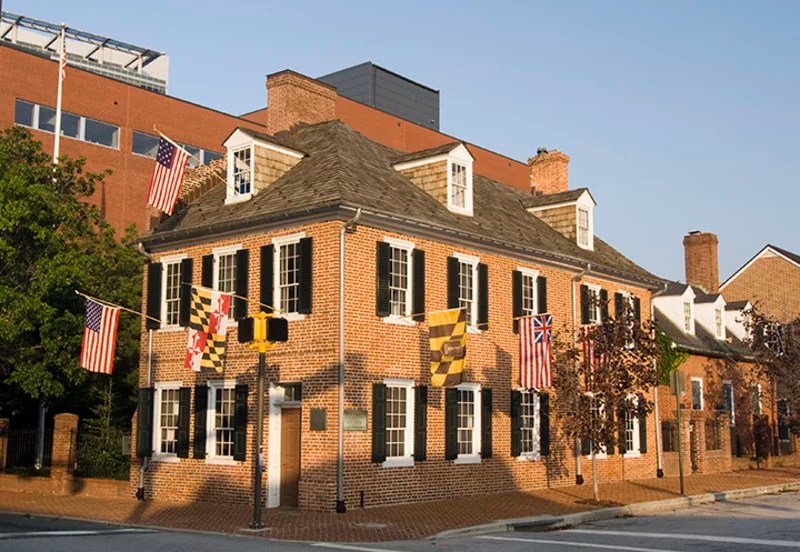
The Mary Pickersgill House at the corner of Albemarle Street and Pratt, just north of Little Italy.
Every April in Fells Point, there is a Privateer Festival to celebrate Fells Point’s maritime history and its history during the War of 1812.


Photos by The Baltimore Sun – Privateer Days 2013
 Baltimore Through My Eyes