Okay, so we all know about the Battle of Baltimore. If you’re from Baltimore you should, if you’re from Baltimore and you don’t? Shame on you. Didn’t your elementary school make at least one trip to Fort McHenry? Defenders Day? If you’re not from Baltimore, listen up. We won. It didn’t take much, but we won. See the previous blog entry.
Anyhoo, the Battle of North Point was preceeded by the Battle of Bladensburg, where, on August 22, 1814, 6,500 American troops had their asses handed to them on a platter by 4,500 Royal Marines. The loss allowed the British army access to the public buildings in Washington D.C. – the White House? They burned it. Along with the Treasury. The Navy Yard had already been burned to keep it from falling into enemy hands. In light of their victory here, they moved north towards Baltimore to destroy the port. Strategically, Baltimore was more important simply because it was a port city, and because it was home to the “clippers” that harrassed British merchant ships. Figuring he had disrupted the American government by burning Washington, British General Ross did not expect much resistance. He had defeated the hastily thrown together force at Bladensburg, so he now moved on Royal Navy ships towards the Patapsco River and Back Creek.
The British had made a huge mistake in burning Washington the way they did. They had added fuel to the fires that burned the White House, the Treasury and other buildings, to make certain that they did burn thoroughly and to ensure they would still be burning in the morning. Big fat case of overkill really. What they didn’t count on, besides pissing off Dolly Madison (who shoved the White House silver into her purse, along with George Washington’s portrait upon fleeing), was the flames and smoke from the fires that they had intentionally set, getting so intense that it could be seen and smelled all the way in Baltimore. Baltimore didn’t panic, it’s citizens just just got really pissed off too, and then it prepared itself. If the British had burned D.C. – what would they do to the port? Don’t mess with our port. President Madison literally climbed on a horse and rode out for hours in an attempt to rally the troops and the people.
At 3 am, 6 British ships dropped anchor near Fort Howard and by 7 am, approximately 9000 British troops and supplies were on the ground and began moving inland toward the area of the old Dundalk Dairy along North Point Boulevard. It was September in Baltimore, and if you know anything about the weather that time of year on the Chesapeake? It’s hot, it’s humid, it’s just plain nasty. The closer you are to the water? The worse it is. British troops are marching in wool uniforms, with haversacks, rifles, etc., so during their march, many of them dropped from heatstroke.
General Samuel Smith of the 3rd Maryland Militia had placed 5 regiments in defensive positions relying on the woods for cover. He was not having a repeat of Bladensburg. He second guessed the British move and sent Brigader General John Stricker to meet them. Because he was dealing with militia, Stricker gave them an unusual order – attack!
Third Brigade – units involved:
- 5th Regiment: Lt. Col. Joseph Sterrett
- York Volunteers (PA): Capt. Michael L. Spangler
- 6th Regiment: Lt. Col. William McDonald
- Marietta Volunteers (PA): Capt. John G. Dixon
- 27th Regiment: Lt. Col. Kennedy Long
- 39th Regiment: Lt. Col. Benjamin Fowler
- Hanover Volunteers (PA): Capt. Frederick Metzger
- Hagerstown Volunteers (MD): Capt. Thomas Quantrill
- 51st Regiment: Lt. Col. Henry Amey
- 1st Rifle Battalion: Maj. William Pinkney
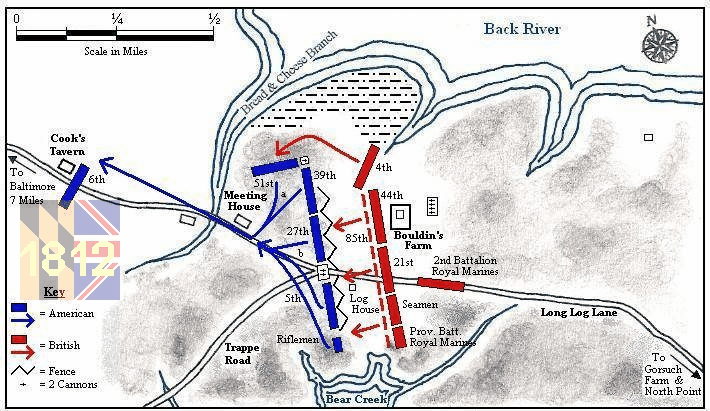
The British then decided to raid some farms and stop to eat breakfast at the Gorsuch farm. That’s right. In the middle of their haste to get to Baltimore to burn it to the ground, they got the munchies. Probably weren’t counting on Stricker drawing them out. He got tired of waiting and figured rather than wait for them to do something stupid after it got dark, he decided to pick a fight. He send Major Heath with 250 men and a cannon down the road to harass the British pickets. The Maryland Artillery literally consisted of four 6-pound cannons. His infantry was protected on the flanks by Bear Creek (west) and Bread and Cheese Creek (east). The 5th Maryland Infantry took positions on the right side of Long Log Lane (Old North Point Road) along with a company of Pennsylvania Volunteers with the 51st Maryland (my 4th Great-grandfather, Nathan Thomas DuVall’s regiment) behind it. The 27th Maryland was placed on the left side of the road with the 39th Maryland and Quantrill’s Hagerstown Volunteers directly behind them.
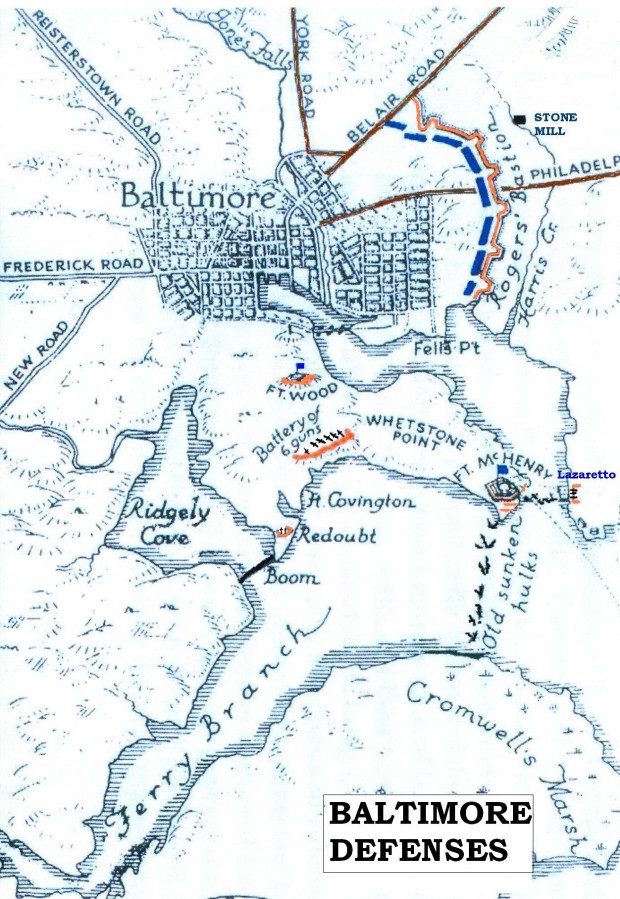
All the ruckus got General Ross’s attention, who literally left his meal to see what was going on. He tried to bring up his main army but was subsequently shot and killed by an American sniper. Per legend, two snipers fired at him with one providing the fatal shot. Again, according to legend it was either Henry McComas or Daniel Wells. Both were teenagers. Colonel Brooke took over for Ross but it took him a while to get organized. The assault on the American troops occurred about 2 hours later. It was disorganized at best and while the British took heavy casualties, they did eventually manage to flank the American guns. Several American units began to run but Stricker turned it into an organized retreat, having his men load cannon with nails, horseshoes, broken locks, hinges, and then fire the hot metal at the advancing troops. Brooke lost troops in the confusion and rather than chase down the retreating Americans (he came within a mile or so of them) he opted to withdraw. Afterall, Fort McHenry was going to be neutralized. He would wait for that. Good thing he didn’t hold his breath. Stricker promptly took his men to the Baltimore Defenses at Hampstead Hill (now the west end of Patterson Park in Highlandtown – called Cannonball Hill now by locals). The American troops there consisted of some 5000 soldiers plus about 15,000 regular citizens, militia, irregulars and volunteers who now stood on the earthworks along with 100 cannon. Brooke, having delayed 24 hours probably regretted his decision. He contemplated a night attack at Butcher’s Hill (then Loudenslager’s Hill) and area dedicated to butchers and tanners who were not allowed south of Baltimore Street. The Royal Navy attempted to silence the battery in what is now Patterson Park, but failed to do so, which curtailed the night attack. The battery, called Roger’s Bastion or sometimes Shephard’s Bastion was merely the centerpiece of 3 miles of earthworks – stretching from Canton all the way north to Belair Road. Brooke gave up, and again, still thinking that Fort McHenry would fall, marched the British army back to North Point, burning the Todd property (Todd’s Inheritance) on their way out. Scouts had witnessed the British landing from there and had gotten word to General Samuel Smith, so out of spite, they burned the house.
Fort McHenry, commanded by Major George Armistead (uncle of Confederate General Lewis “Lo” Armistead – killed at the Battle of Gettysburg), was 1000 strong, and had already sunk several merchant ships to plug up the harbor in order to waylay the British ships. By 6:30 am,19 of them dropped anchor just out of range of the Fort’s cannon, and for 25 hours, pounded away at its walls. Because it had been recently re-fortified, (Baltimore was expecting to be attacked by the British eventually) so there was very little damage despite being pelted with 1500 to 1800 cannon balls. There were only 4 casualties – one was a gun commander, Sgt. Clem, killed by shrapnel. There was also a civilian woman killed while carrying supplies to soldiers in the fort. A cannon ball also hit the powder magazine but by some miracle it didn’t explode. General Smith had managed to place 56 long-range cannons at the fort and re-enforce the walls, so damage was minimal. On September 14, the oversize flag went up for reveille, replacing the tattered storm flag from the night before (it had rained or rather deluged along with a thunderstorm). The city was dark, with orders given to extinguish fires and candles so as not to give the British any sort of stationary target. A British landing party, hoping to draw the attention of the army at the city’s eastern defenses, took pot-shots at it before returning to their boats. The fort never had to return fire during barrage of cannon-fire and rockets, the British ships were out of range and seeing the harbor defenses at Forts Covington (10 guns), Battery Babcock (6 guns) and Fort Lookout/Wood, and the guns at the Lazaretto Redoubt/Gorsuch Point (3 guns) (home of the old smallpox hospital), they never navigated around the sunken ships at the mouth of the harbor and into what would have been the “kill zone”. They attempted a diversionary tactic by sending 20 barges west of Ft. McHenry toward Ft. Covington but they were promptly blown to bits. Despite having cannon on 19 ships, they had the good sense to realize that they would have been outgunned were there to attempt to get closer to the city, so early in the morning of the 14th, they ceased the bombardment. By the dawn’s early light, as it were, the flag, the fort and Baltimore’s defenders were still there.
Colonel Brooke withdrew completely this time. They had not breached the fort and thus had no idea of how many men it held. He had been ordered not to march on any part of Baltimore unless he knew without a doubt that the fort held less than 2000 men. He had no clue that in actuality there were half that number present, but because he had no idea and had to follow orders – he retreated. Admiral Cochrane’s fleet left Baltimore’s harbor and sailed to New Orleans.
British ships involved, under Vice Admiral Sir Alexander Cochrane, Royal Navy – they were:
One Rocket ship – HMS Erebus
Five Bomb Vessels – HMS Terror, HMS Aetna, HMS Meteor, HMS Devastation, HMS Volcano
Seven Frigates – HMS Surprise (yes Captain Aubrey’s ship from Master and Commander fame was named for this one), HMS Severn, HMS Hebrus, HMS Euryalus, HMS Seahorse, HMS Havannah, HMS Madagasacar
Three Schooners – HMS Wolverine, HMS Rover, HMS Cockchafer
While there were 19 British ships – there were only 4 American ships and 3 were anchored near Fells Point/Canton. There were the USS Java (built in Baltimore but moored without a crew), USS Erie (also berthed without a crew) and the USS Ontario (crewed and outfitted with 16 guns, but also blockaded in the harbor).
The 4th ship was possibly the USS President – the truce ship that Francis Scott Key was on. Note that I say “possibly” – the name has eluded folks to this day. Key was originally aboard the HMS Tonnant, Admiral Cochrance’s flagship, but after he successfully negotiated for the release of Dr. William Beanes, he was then transferred to the HMS Surprise and then back aboard the truce ship, which was tethered to the Suprise. The British wouldn’t free them to Baltimore, simply because by the time negotiations had finished, they knew about the British positions and had obviously heard the plan to eventually attack Baltimore. So they watched the entire bombardment from the deck of the ship,
North Point:
3,000 troops- regular infantry, militia and 6 cannon
Hampstead Hill
10,000 regulars
2,000-5000 infantry militia – 3000 of these troops had retreated from North Point
100+ cannon
Fort McHenry:
1,000 infantry milita
20-30 cannon and 10 gun water battery + 56 long range cannon
Additional Defenses (Fort Covington, Battery Babcock and Fort Lookout/Wood plus the Lazaretto Redoubt, the Ferry Point Battery protecting the log boom at the mouth of Ridgely’s Cove, and the Spring Garden battery):
8,000 militia
150+ cannon
Total:
22,000-25,000 troops and almost 300 cannon
Battle Monument (sitting on N. Calvert Street near the courthouses) was built between 1815-1825 to commemorate the battles and lists the 39 battle dead. You can see it featured in “Live Free or Die Hard” because parts of the movie were filmed here. Unfortunately, as is the case with a lot of movies, Baltimore was doubling for Washington D.C. so folks tend to think that the monument is actually there and not in downtown.
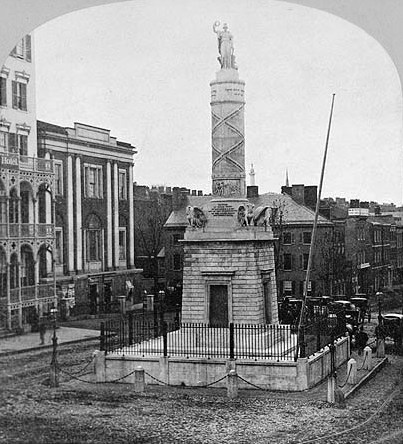
Battle Monument – Maryland Historical Society photo – the monument is the symbol of Baltimore – adopted for use on the city seal in 1827.
Sources:
https://chap.baltimorecity.gov/monuments-and-conservation/battle-monument
https://www.nps.gov/fomc/learn/historyculture/north-point-pt-1.htm
https://en.wikipedia.org/wiki/Battle_of_North_Point
 Baltimore Through My Eyes