The media has exploded about Confederate symbols. And honestly? Some stuff belongs in museums – not out in the open to be glorified – so yeah – fix that please. So while they’re on about that – and the Maryland Song, and the Battle Flag, and etc…. blah blah blah, I figured I could, at the very least, set the record straight about Maryland and Baltimore during the Civil War. I am a bit of a buff so bear with me. Mind you, I firmly believe that neither side gets a pass during that awful conflict and Maryland falls right in there because it was a border state. And before you scream that it was all over states rights? A reminder. Those so-called states rights? Were the rights of the states to keep slaves. As in human beings. In slavery.
Maryland has the distinction of having the first fatalities in that war (Battle of Baltimore/Baltimore Riot) and the bloodiest day of combat in American military history (Antietam/Sharpsburg). Maryland also had the distinction of being half industrial (Baltimore area) and half agrarian (Eastern Shore). This presented a problem in 1860 when Lincoln won the election. While there was little appetite for secession, only 2% of the population actually voted for Lincoln. Maryland realized that secession and war would affect trade and they also knew that the border with Pennsylvania would be difficult to defend. They had also figured out that the Union Navy would sail into the port and mess things up royally, so they did their best to avoid any sort of military action in response to secession. They weren’t that lucky. Lincoln knew that if Maryland did leave the union, it would leave the nations capitol surrounded by Confederate states and he also knew that the only railroad link from D. C. to the north – went through Baltimore.
Most folks from Baltimore were anti-war. About half of Maryland’s black citizens were free and the majority of those lived in Baltimore. In fact, Baltimore had the country’s largest population of free blacks – about 25,000 people. Unfortunately while Baltimore was anti-war, it was not anti-secession, and both groups organized themselves into militias. The National Volunteers were the pro-slavery/pro-secession group and the Minute Men were the unionists. This obviously created a tremendous amount of tension in and around the city.
The Civil War began at Fort Sumter (no casualties) on April 12, 1861 and when Virginia left the Union on the 17th because of Lincoln’s call for troops to suppress the uprising; secessionists in Maryland agitated to go with Virginia. Hostility increased and on April 18th, 460 fresh troops from Pennsylvania (later known as “The First Defenders”) arrived at the Bolton Street Station on Howard Street (present site of the Fifth Regiment Armory) and marched with US Army troops also newly arrived from out west. The troops were under the command of John Pemberton, who would later resign to serve the Confederacy. They marched to Fort McHenry and reported for duty, but not before being harassed by a group of National Volunteers, who threw bricks and stones and insults. The Baltimore City Police Department intervened and saw to it that the troops were relatively unmolested. Unknown to the crowd, the troops were marching with unloaded weapons and some were completely unarmed. The troops from Pennsylvania made it to Camden Station and went on to D.C., the US Army troops settled in at Fort McHenry.
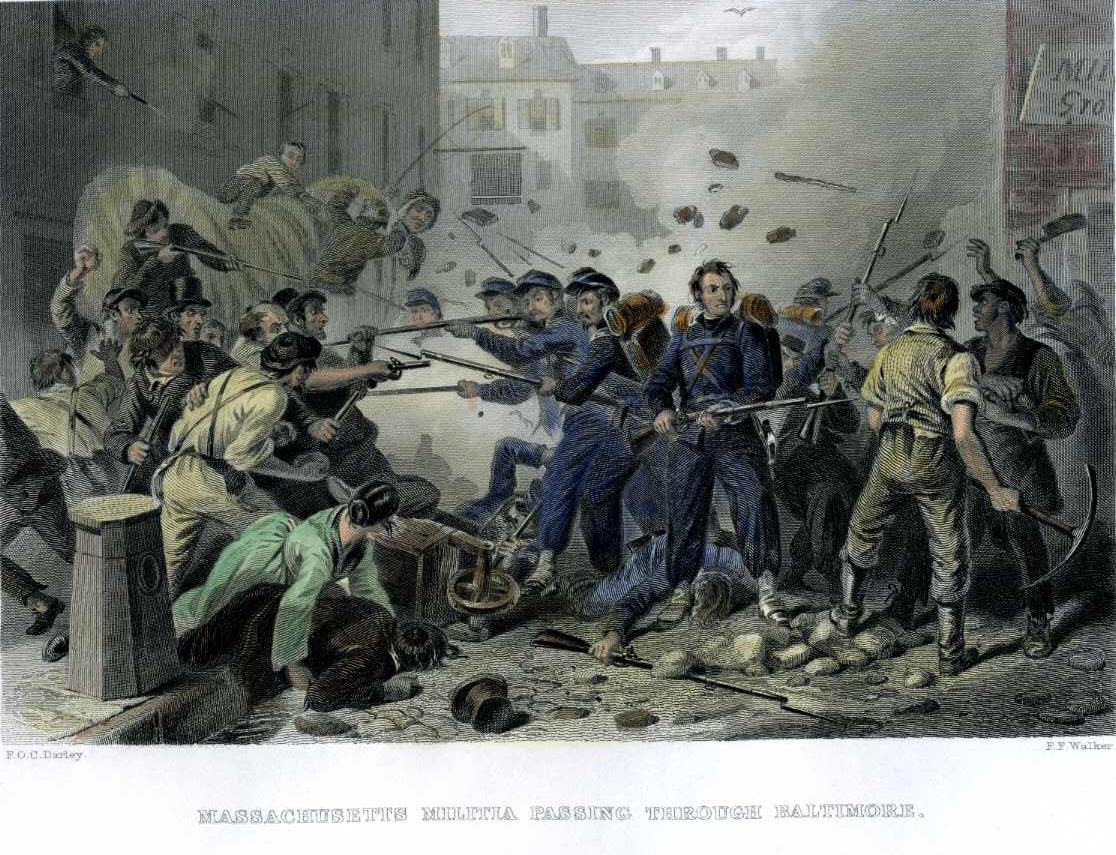
On April 19, more troops arrived from Massachusetts. The 6th Massachusetts left Boston on April 17 arriving in New York on the 18th. They were in Philadelphia by the evening of the 18 and by the 19th they were in B-more. They came in on the PW&B rail line and got off at the President Street Station (near Little Italy). Because of an ordnance prohibiting train lines in the city proper – the soldiers had to transfer to a horse drawn rail car, which would take them across Pratt Street to the Camden Station. The horse drawn cars were subsequently attacked and Pratt Street was blocked, so the unit was ordered out of the cars to march ten blocks between stations. Colonel Edward Jones gave the order:
“The regiment will march through Baltimore in column of sections, arms at will. You will undoubtedly be insulted, abused, and, perhaps, assaulted, to which you must pay no attention whatever, but march with your faces to the front, and pay no attention to the mob, even if they throw stones, bricks, or other missiles; but if you are fired upon and any one of you is hit, your officers will order you to fire. Do not fire into any promiscuous crowds, but select, any man whom you may see aiming at you, and be sure you drop him.”
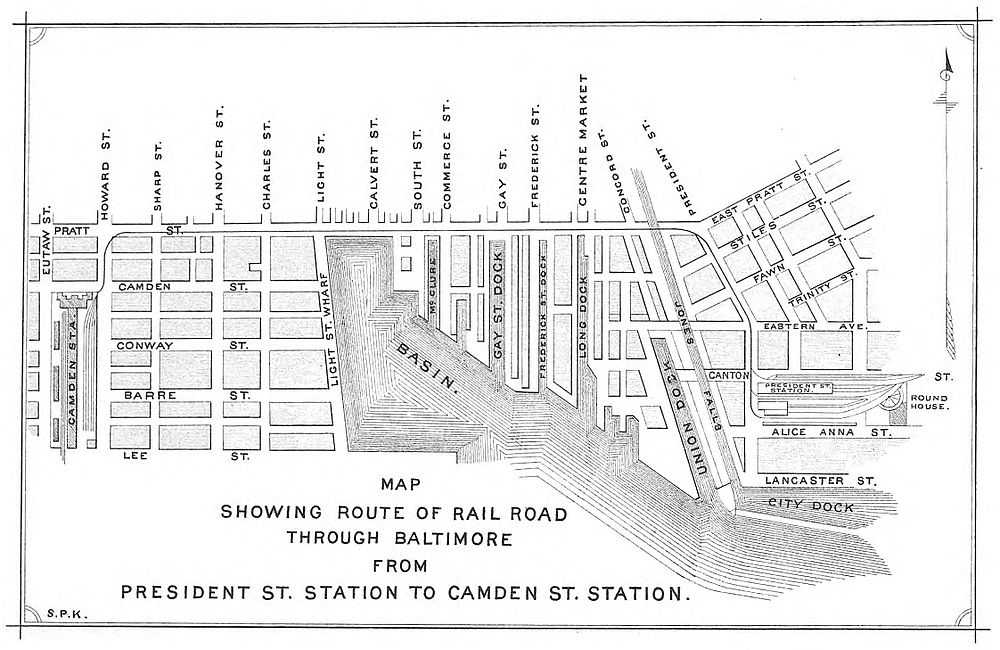
The George Brown map detailing that route troops had to take from the President Street station to Camden Street Station.
The unit began to march but was attacked again by the mob, who broke shop windows and again blocked up Pratt Street. Finally the soldiers fired, which of course caused complete pandemonium. A brawl ensued and it was the Baltimore Police who again saved the day by separating the mob and keeping them away from the soldiers. At the end of the day though, while the troops made it to Camden Station, 4 were dead and 36 wounded. It is unknown how many civilians were injured and at least 12 were killed – but despite being killed by civilians in what was considered a Union State, those 4 soldiers are considered the first casualties of the Civil War. They were Corporal Sumner Needham of Co I and Privates Charles Taylor, Luther Ladd and Addison Whitney of Company D.
More skirmishes occurred throughout the month between civilians and the police. (sound familiar?) Pro Union newspaper offices were looted and destroyed. But most people were cleaning up the mess and were back to business as usual. The mayor (Brown) and the governor (Hicks) begged Lincoln not to send any more troops through Maryland and instead re-route them through Annapolis. Lincoln ignored the request despite a letter from Brown.
“It is my solemn duty to inform you that it is not possible for more soldiers to pass through Baltimore unless they fight their way at every step. I therefore hope and trust and most earnestly request that no more troops be permitted or ordered by the Government to pass through the city. If they should attempt it, the responsibility for the bloodshed will not rest upon me.”
Because he got no response from D.C., Brown mobilized the Maryland Militia and destroyed the railroad bridges into the city. Hicks then called for the state legislature to meet in a special secession and vote on secession. They met in Frederick because Annapolis was, by then, occupied by Federal troops and Baltimore was still reeling from the riot, not to mention full of pro-Confederate sympathizers. On April 26, 1861, they actually voted to not secede, stating that there was no constitutional authority for it, and from what I’ve read, desperately wanted to remain neutral. Hick was also afraid for Frederick City as it was called then, because of its proximity (20 miles or so) to Harper’s Ferry, that fact that Jackson was there, and because it was a hub for supplies going south. He sent a letter to General Patterson.
“FREDERICK CITY, MD., June 9, 1861.
General PATTERSON,
Comdg. U. S. Forces at or near Chambersburg, Pa.:
Whereas Lieutenants-General Scott has authorized me, by an accredited messenger, to make a requisition upon you for a detachment of troops, to be sent to Frederick City, if in my discretion I deem it necessary for the public welfare; and whereas the city of Frederick is at any moment liable to attack by the rebels at Harper’s Ferry and vicinity; and whereas stores and provisions are daily sent from this city and vicinity to Virginia, in aid and comfort of the enemy, I having no means at my disposal of preventing said transportation of stores and provisions:
Now, therefore, I, Thomas H. Hicks, governor of Maryland, do, by this my requisition, call upon you for such detachment of the troops under your command as you, in your military knowledge, may deem sufficient for the purposes indicated, provided your response for this requisition will not interfere with the safety of the great interests confided to you.
I have the honor to be, with high respect, your obedient servant,
THOS. H. HICKS.”
The growing conflict never allowed true neutrality because in May, General Benjamin Butler arrived quietly with more soldiers and promptly declared martial law. His Massachusetts troops took possession of Federal Hill and trained their cannons across the harbor at the city, threatening to destroy it if attacked. He fired off a note to the garrison commander at Fort McHenry advising him to do the same. The mayor and other pro-slavery politicians were arrested and thrown in Fort McHenry and when Francis Scott Key’s grandson wrote about it – he was locked up as well. The Chief Justice of the Supreme Court had a meltdown and declared Lincoln’s suspension of habeas corpus unconstitutional. Lincoln ignored him too.
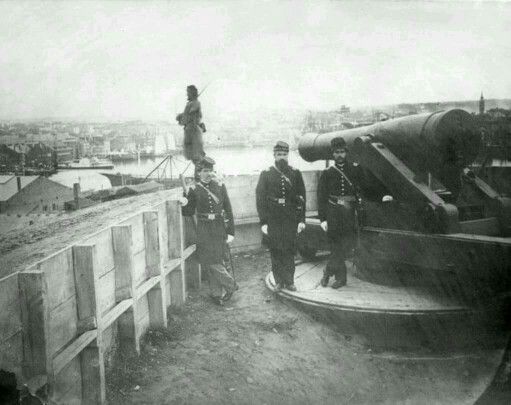
Union Troops under Butler with their cannons trained across the harbor on Baltimore’s financial district.
In June, Baltimore’s Chief of Police, George Kane, was arrested and the police department replaced with 250 Unionist volunteers and the 1st Regiment of Maryland Volunteer Infantry US (not to be confused with the 1st Maryland Infantry CS). The Board of Police refused to recognize the new police, and they too were arrested and sent to Boston.
By September the state legislature met again to discuss the matter of habeas corpus and because of that one third of the General Assembly was arrested by Federal troops as well, authorized by McClellan. The total number of arrests made was probably close to 16. A military necessity according to McClellan and approved by Governor Hicks. There was no more major unrest, but all the unrest did cause “Maryland, My Maryland” to be written. The words were penned by poet and journalist James Ryder Randall (yes folks – his family formed Randallstown) upon hearing of the death of a friend who was shot during the riot.
Maryland ultimately sent troops from both side to the war – more Union than Confederate. Delaware, after seeing the unrest in Maryland, opted to send no one at the beginning of the war, but finally reneged sending only Union troops, despite being considered a slave state.
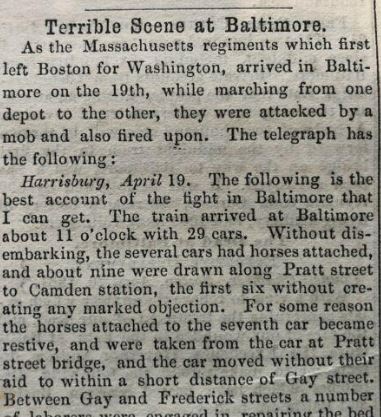
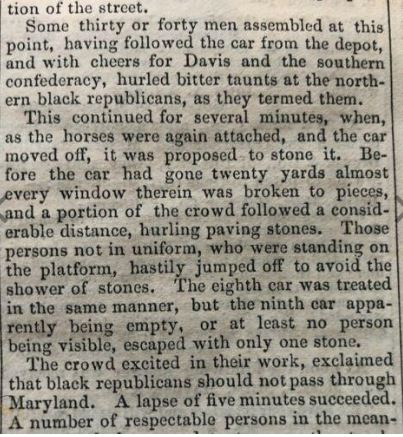
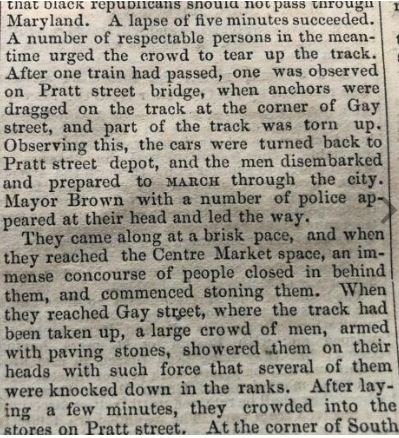
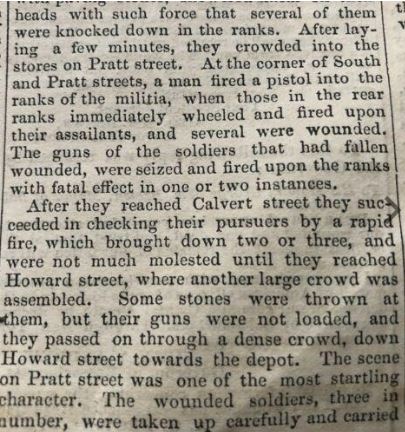
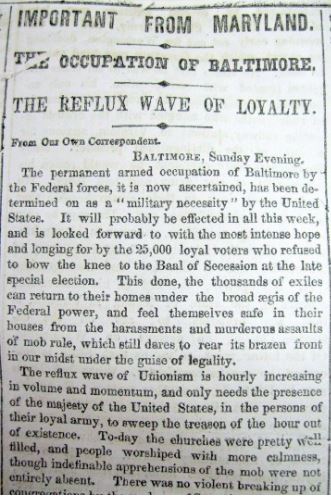
Excerpts from a Worcester, Massachusetts newspaper and another article describing the riot.
 Baltimore Through My Eyes