I had a conversation with a teacher at work who is also a Civil War buff like me. She asked about things in the area so I told her about Corbit’s Charge. I figured I’d post it here too. It took place in Westminster on June 29th, 1863. Also known as the Battle of Westminster, it was really more suicidal courage than it was anything else.
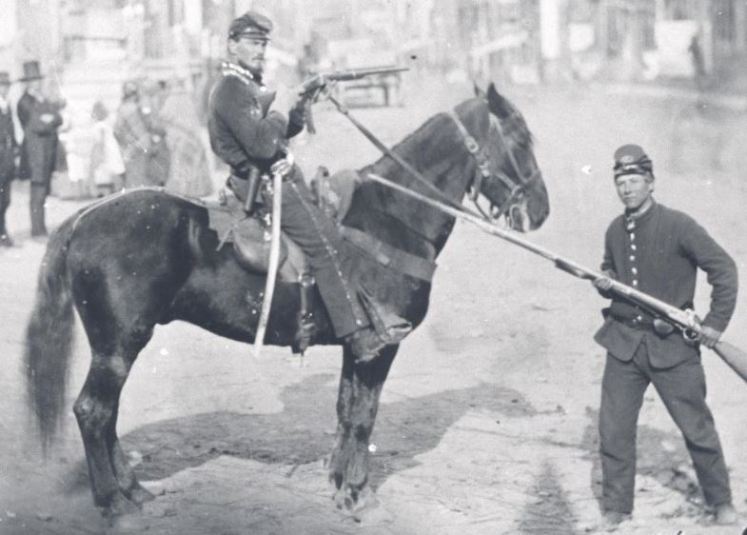
A Delaware trooper on his horse with a member of the 150th N.Y. Infantry. The mounted soldier is thought to be Major Knight. This is the only known Civil War photo of Westminster. Photo from Wikimedia Commons, the Thomas Gordon Collection.
Let me preface by saying that the area around Reisterstown was very pro-Confederate during the Civil war – most likely because the area was rural and contained many farms. As a result, the 1st Delaware Cavalry was deposited there by Lincoln to keep the peace. On June 28th, two companies, C & D, (about 90 men) were sent to Westminster to guard the rail depot for the Western Maryland Railway. The tracks still cross Main Street. The depot was part of the main line to Baltimore and was essential for supplies to Washington D.C. and the Union Army. Commanded by Napoleon B. Knight, Captain Charles Corbit and Lieutenant Caleb Churchman were his company commanders. Commissioned at age 21, Knight had no military experience. Prior to their arrival on the 28th, the town had been occupied 16 or so members of the 150th NY Infantry who were stationed there as Provost Guards.
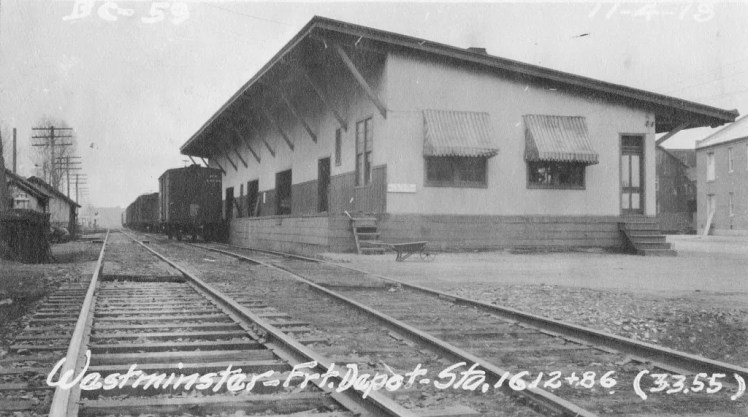
The Westminster Depot – the building is still there although it is currently in use as a business. Photo from kilduffs.net
By June 1863, the Confederates had moved north and Washington didn’t want the rail line cut, so in went the boys from Delaware because apparently there wasn’t a whole lot happening in Reisterstown. They arrived in Westminster late in the morning of the 28th. Unbeknownst to them, James Ewell Brown “Jeb” Stuart and three brigades (about 4000 men) of Confederate Cavalry had made their way around Washington to the west and had successfully captured a Union supply train near Rockville with about 150 wagons. They were headed north following closely behind the Union Army who was chasing the Confederate Army. If you’re familiar with the Battle of Gettysburg, you know that the Union Army was moving north in hot pursuit of the Lee and the Confederate Army (who had managed to move north of South Mountain near Hagerstown) and at the time were pretty much spread out all over Carroll County. The Confederates had already wreaked havoc in Howard County and Sykesville, tearing up B & O Railroad tracks there and at Hoodsville, burning the Howard Cotton Factory to the ground and stealing the leather belts from the machinery to repair their shoes.
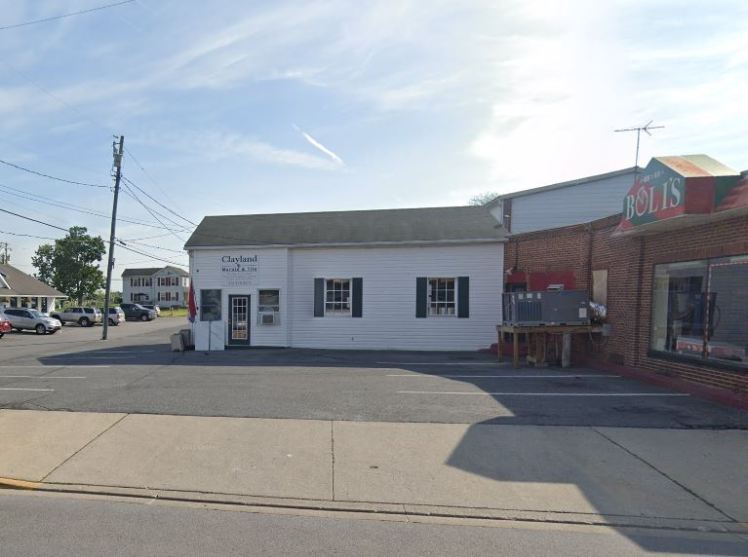
Site of the blacksmith shop – corner of Main and Bishop Street – photo from Google Streetview
The wagon train slowed Stuart down, but he continued north towards Westminster and came into town from the south. On June 29th, several members of the Delaware Cavalry decided to visit a blacksmith near the corner of what is now Washington Road and Main Street (Main and Bishop) to get shoes for their horses. The units horses were in a bad way and most needed to be shod. The rest of the cavalry was camped out on college hill above the town. When the troopers arrived at the smithy, they ran smack into the 1st (310 men) and 4th (544 men) Virginia Cavalry and were promptly taken prisoner. Well meaning citizens ran up to college hill (called the Old Commons and now the site of McDaniel College) and informed Captain Charles Corbit of the dilemma. Outnumbered 10 to 1, Corbit rallied his now 80-some men and charged down main street, sabers drawn, to clash with the Confederates. He had turned to the Major for orders (standard operating procedure would have been to withdraw) but because Knight was drunk, having spent the day in a bar in the Westminster Hotel and Tavern which sat at the corner of Main and Court Street, he ordered Corbit to take the field and then promptly refused to leave the hotel. Why? Because at the beginning of the war, Knight was pro-Confederate and had volunteered his services to that side only to change his mind while working for Delaware’s A.G. He was firstly, most likely entirely too drunk to ride, and secondly, he was worried about being captured and deemed a traitor by the Confederates.
Obviously outnumbered, Corbit and Churchman were taken prisoner and Stuart’s troopers chased what was left of the Delaware Cavalry (half had been captured) back into Reisterstown. Wounded were treated in homes along Main Street. Corbit lost two men (a corporal and a private) and the Confederates also lost two men, which forced Stuart to spend the night in Westminster while they figured out where to plant their deceased troopers. Initially all 4 deceased solders, Union and Confederate were buried in Westminster Cemetery (the Union Meetinghouse Cemetery) – just a block from Main Street. The Confederate burials angered townsfolk and eventually those soldiers were disinterred and reburied in the cemetery at Ascension Episcopal, right across the street. One of the soldiers, Lt. John William Murray, 4th VA Cavalry, is still there. The other soldier, Lt. Pierre Gibson, also 4th VA Cavalry and a friend of Murray’s, was reburied after the war.
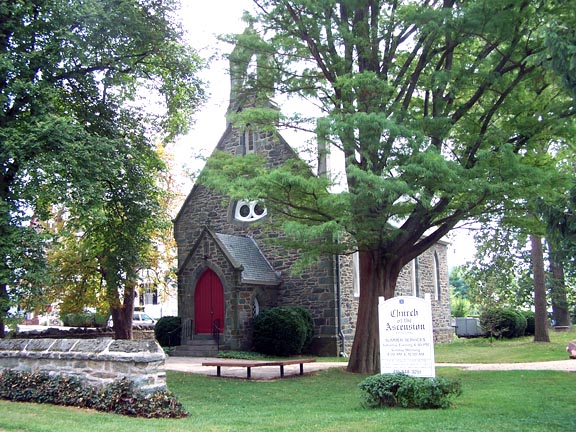
Church of the Ascension in Westminster – photo by Janet Greentree at FindAGrave
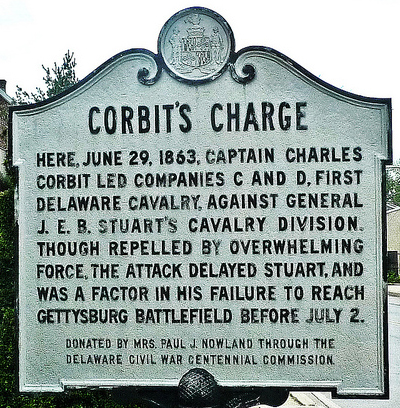
The skirmish, despite the fact that it was a minor victory for the Confederates, delayed Stuart’s arrival to Gettysburg (he arrived on the 2nd) leaving Lee without the intelligence that his cavalry usually provided and largely contributing to his defeat.
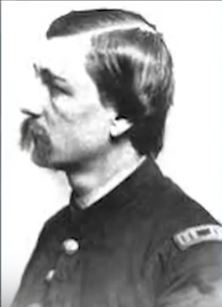
Unsung thanks for the Union victory at Gettyburg goes to Captain Charles Corbit and his 80 troopers from Delaware. Corbit was 25 at the time. Born in Odessa, Delaware, Corbitt had quite a different experience as opposed to his commanding officer. He grew up at the Corbitt-Sharpe House where his mother had hidden a runaway slave in 1845. Because of the encounter with the man, and the fact that he reached freedom in Philadelphia, the house is now designated as part of the Underground Railroad network.
The only slight to the town of Westminster itself was the disappearance of the flag that flew over the courthouse. It was hand sewn by 13 of the towns ladies, who had stitched their names on the stars, and was stolen by pro-Confederates and given to Stuart who took it back to Richmond when he went. Despite several attempts to find it and return it, all were unsuccessful.
____________________________________________________________________
Sources:
http://www.westminstermd.gov/265/Corbits-Charge
http://carrollcountytourism.org/wp-content/uploads/2013/04/Corbits-Charge-Tour.pdf
Civil War Documentary – “Corbit’s Charge” – Producer Rodney Roldan, 2013
The Historical Society Of Carroll County
The Gettysburg Daily
delawaretoday.com/life-style/how-connections-made-napoleon-bonaparte-knight-a-calvary-officer
 Baltimore Through My Eyes