I seem to be in a American Revolution/Civil War/This Old House mood, so I figured I’d talk about one of my favorite places in Baltimore County – Hampton Mansion. Built between 1783 and 1790 for Charles Ridgely III, it was called “Ridgely’s Folly” and at its height, encompassed some 25,000 acres. The land was originally part of a grant called Northampton given to Col. Henry Darnall in 1695. Darnall, a relative of Lord Baltimore, died in 1711 and by 1745, his heirs had sold the property to Colonel Charles Ridgely II, Ridgely III’s father. The colonel was a merchant and planter and a member of the Maryland General Assembly in addition to being a vestryman at Old St. Paul’s in downtown. He earned his commission in the Maryland Provincial Militia.
In 1760, the Colonel and two of his sons, John and Charles III, opened the Northampton Iron Works and by 1764 were shipping thousands of pounds of pig-iron to London. The furnace was located on Patterson Run, with forges near the Gunpowder Falls. One of ten ironworks in Maryland, it formed an important part of Maryland’s colonial industry. When the American Revolution began and trade with Britain ceased, the ironworks began supplying cannon and cannon balls for the colonial army in addition to kettles and household tools. The ironworks property itself expanded to 2000 acres, thanks in part to war time profits, the buying of confiscated Loyalist land, the labor of British POWS and convicts, indentured servants and slaves. The Colonel died in 1772 and left 2/3 of the property to his son, Charles III, his elder son John having died in the previous year in 1771. The other third was divided between his three daughters. He had, at the time, 32 slaves, 6 servants, about 620 pounds (96,000 pounds today) worth of goods, 322 pounds (about 50,000 pounds today) invested in the iron works and an estate worth about 6285 pounds, or close to a million pounds today. Abandoned in 1850, what is left of the furnace still sits beneath the Loch Raven Reservoir.


All that is left of the Northampton Iron Furnace.
The same year the ironworks opened, Charles Ridgely III married Rebecca Dorsey. After the American Revolution ended, Charles III began work constructing what would eventually become Hampton Mansion on his already extensive property. The family business had expanded beyond pig-iron and now included apple orchards, marble quarries and gristmills, although the ironworks was still a major contributor to the family wealth. When it was completed in 1790 it was the largest home in the United States. Sadly, Charles had very little time in his completed masterpiece – he died the same year it was finished.
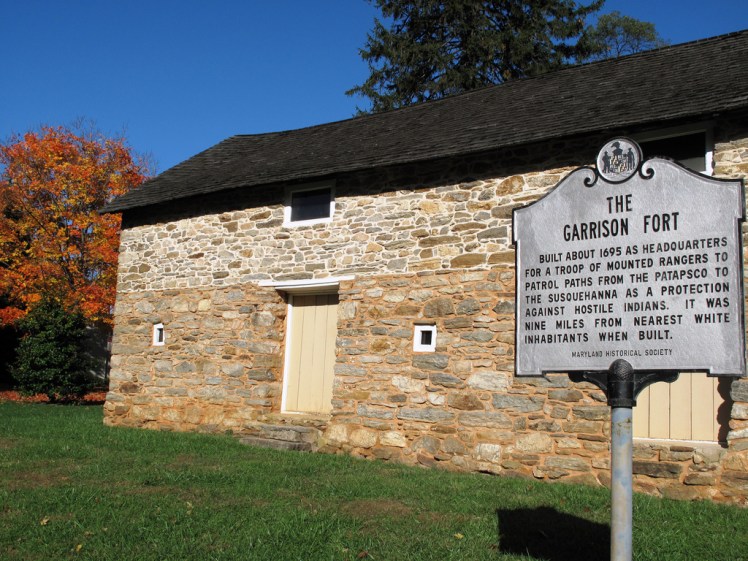
Ridgely referred to it as his “Plantation in The Woods” – and not without good reason. There were still Native Americans in the area and the closest point of defense was Fort Garrison. Commissioned in 1693 by Maryland’s Royal Governor, Sir Francis Nicholson and built in 1695, it’s 2 foot-thick walls and fire-proof roof were designed to withstand attacks and was garrisoned by mounted troops. Situated on the Slaughterhouse Run branch of the Jones Falls between two Indian trails (The Old Court Road and Rolling Road) used by the Delaware and Seneca, soldiers rode all over the area (Patapsco to Susquehanna) to protect “the frontier” and guard the commerce that was starting to flow over the roads. It was also used in 1755, during the French and Indian War. The fort and its rangers sat a good 10-12 miles from the Hampton property – a distance that would have been an eternity on horseback or in a carriage in the mid 18th century. The grand house was therefore designed with the same thick walls and it’s myriad of windows are shuttered from the inside.
Charles and Rebecca had no children, so he left his estate to his nephew, Charles Ridgely Carnan, the son of his sister Achsah and her husband John Carnan, with the condition that he change his name to Charles Carnan Ridgely. He did in 1790, and with his wife Priscilla Dorsey, (younger sister of his uncle’s wife Rebecca Dorsey) became the 2nd Master of Hampton. He expanded the property, and added corn, beef cattle, dairy, hogs and horses to the family’s interests. He put a racetrack on the property and the terraced gardens behind the house were created and irrigated. Hampton flourished under Charles and his large labor force of artisans, bricklayers, clerks, stewards, masons, blacksmiths, wheelwrights, sailors (Ridgely owned a fleet of merchant ships) doctors, bookkeepers, and other contractual positions in addition to his indentured servants, and slaves, Hampton functioned much as a tiny nation would. He served as Maryland’s governor from 1816 to 1819 and with over 311 slaves working the fields, and at the ironworks, he was one of the largest slaveholders in Maryland. By 1860, the family was the second largest slave-holding family in Baltimore County despite a large portion of them being freed in 1829 on the death of the governor. His will stated that women between the ages of 25 and 45 were to be freed, and males between the ages of 28 and 45 were to be freed, making it the largest manumission ever in the history of the state. Slaves over 45 years of age were considered elderly and were to be cared for by Ridgely heirs – mostly his daughters, who swore oaths to, but at least 90+ were freed, despite a challenge to the will by two of his son-in-laws, who wanted all the slaves sold and the profits split between the heirs.
Some of the governors manumitted slaves settled close in the areas known as Sandy Bottom (York Road from 695 to Bosley Ave), East Towson, and on Railroad Ave in Lutherville, rather than move to Baltimore City. Old Mt. Olive Baptist Church still stands in Sandy Bottom (at the corner or York and Bosley, as does it’s cemetery, Pleasant Rest, at the corner or Bosley and Kenilworth. There is a 1945 burial for a John Ridgely, husband of Hattie Carroll, which in and of itself should be a huge clue to anyone who understands the history of Baltimore, that the African-American people from this area originated from the slaves of the enormous properties around the city.
At age 39, John Carnan Ridgely, the son of Charles and Priscilla, became Hampton’s third master. He was married to a distant cousin, Miss Eliza Eichelberger Ridgely, the daughter of a merchant. When John inherited the house and 4500 acres, Eliza set about the very serious task of overseeing the plantations finances. Several of her financial ledgers and records have been preserved, which include everything from household finances, to travel expenses, Christmas presents, as well as expenses for clothing and shoes for all of the Hampton slaves. She oversaw weddings and funerals in the home, had servants and slaves married by clergy and insisted on church services for them in the carriage house. John and Eliza were the last Ridgelys to own slaves, but unlike his father, John bought 60+ slaves and only freed one. When he inherited his father’s estate, he had virtually no slaves and thus, he spent 6000 dollars beginning in September of 1829 to re-populate the slaves quarters on the property. He spent 11 months buying from estate sales, dealers and holders.
In 1867 when John died, the property passed to his son, Captain Charles Ridgely. Born in 1838, he was elected Captain of the Baltimore County Horse Guard at the age of 23. When the Civil war started, Ridgely was threatened with arrest by the commander at Fort McHenry along with Harry Gilmor and John Merryman – also members of the unit. Ridgely’s father managed to prevent the arrest and the cavalry unit was consequently disbanded, however, Gilmor, a friend of Ridgely’s wasn’t so lucky and spent some time in the prison at the fort. Merryman was imprisoned too on a charge of treason (destroying 6 railroad bridges and telegraph lines along tracks will definitely piss off the Commander in Chief especially when he’s trying to conduct a war) and sparked the famous Supreme Court Ex parte Merryman case. Under threat of arrest (because you just know he was there too when those bridges were burned), and probably threatened with disinheritance by his father, Charles stayed inactive during the war. He and his wife, Margaret Sophia Howard (granddaughter of John Eager Howard) with their southern sympathies, eventually fled to Europe and conducted business regarding the mansion through lawyers and overseers and the home remained blissfully untouched. Hampton began to decline after the Civil War because of economic hardship and the end of slavery, and when Charles died in Rome in 1872, his son John “Jack” Ridgely inherited only 1000 acres. 3500 had been sold to keep the estate running.
The estate still had apple orchards and generated an income from apple cider and from milk from the Hampton dairy, but by 1929, Jack and his son, John Jr., who would become the 6th Master of Hampton in 1938, began selling off most of the remaining 1000 acres. In 1948, John Jr. moved his family back to the original 1745 farmhouse and turned the mansion over to the Avalon Foundation who had it declared a National Historic Site. Preservation Maryland opened it to tours in 1949 and in 1979 the National Park Service acquired the site and added more acreage onto the 43 that were left, bringing with it original structures and bringing the total acreage back up around 60.


Hampton today – photographed by me on a trip in May. The Lebanon Cedar was brought from Europe by Eliza Ridgely in a shoebox. Part of the terraced gardens are still maintained by volunteers. The original farmhouse still stands across the road, along with the slave quarters, the dairy and other outbuildings. The carriage house and stable are also on the property, along with several carriages. It is a beautiful place, and standing on the grounds, much of the modern world disappears completely and I am thrust back into the 18th and 19th centuries, to a time before economic and moral changes ended this way of life. I love to go there and show it to folks who have no idea that sits just off the beltway near Towson. The rangers there are amazing and do depictions in period garb of what life was like at the property as slaves and servants. Period dances are held in the Orangerie, Yuletide is celebrated and the mansion decorated period trimmings, tours are given daily and the beautiful thing is that most of it is blissfully FREE.
 Baltimore Through My Eyes