Two ships? Did you know?
US Frigate (1797-1853)
The first ship given the name Constellation was built in 1797 by David Stodder and Thomas Truxtun at the Sterret Shipyard in Baltimore and was launched September 7th of that year. The shipyard was marked by Harris Creek (a tributary of the Patapsco) in what is now Canton and was located where Boston Street and Lakewood Avenue are today. Owned by Samuel and Joseph Sterrett, the yard had sheds and a smithy and more importantly, a road into Fells Point – necessary for supplies and workers. Stodder was an experienced builder at the shipyard and he owned 17 slaves. Designed by Joshua Humphreys and Josiah Fox, the Constellation was one of six frigates commissioned by the Navy to chase pirates as far east as the Mediterranean. Stodder was a bit of a problem for the War Department and there are several letters highlighting his “unsatisfactory pace” in completing the Constellation, questions why, Stoddard’s responses, another letter telling him to literally move it or lose it, a request to close his account with the War Department because he owed the US money for nails and iron, and so on and so on, etc. ad nauseum. Stoddard also altered the original designs of the ship which most likely didn’t go over well either.


Above left – a portion of a painting depicting the original ship, by John W. Schmidt. No photos of the ship exist but it can be assumed that she very closely resembled the USS Constitution, built and launched from Boston Harbor the same year. Above center and right – letters to and from Stodder regarding the building schedule of the ship.
Nicknamed the “Yankee Racehorse” and costing $314,212.00, the ship had a displacement of 1,265 tons; it was 164 feet long; it’s beam was 41 feet; the draft (depth of it’s hold) was 13 feet, 6 inches; it had a crew complement of 340 officers and enlisted men; and an armament of 28 – 18 pounder long guns and 20 – 32 pounder smooth-bore cast iron cannons. Built out of oak and cedar, she was a bit longer and narrower than other ships, allowing her greater speed but with heavy framing which gave the hull more strength. The object was to build her to overtake other frigates but still have the speed to escape the heavier “ships of the line.” Built to hold 36 guns (Naval Act of 1794), because of her size, she could and did carry up to 48 guns depending on who her commanding officer was. She is thought to have been named “Constellation” by George Washington because of the 15 stars on the US flag at the time. I’ve not seen any proof though.
Initially used to haul American merchantmen, the ship was finally sent to the West Indies in December of 1798 to protect US interests there. In a quasi-war with France, Constellation battled the 36 gun French frigate L’Insurgente and two smaller private privateer ships, the Diligent and the Union. The L’Insurgente was the fastest ship in the French Navy, whose job was commerce raiding – i.e. she was also a privateer. Raked by several broadsides and faced with 24 pound cannonballs, the French captain surrendered, marking the first naval victory for an American built ship.
She was not so lucky against La Vengenace, a 52 gun frigate who struck her mainmast and disabled her. While unable to capture the French ship because of the extensive damage to the rigging and without her mainmast, Constellation returned to Jamacia, and the badly damaged (worse damaged really) La Vengenace grounded herself to avoid sinking altogether. While the battle was technically a draw, the captain of La Vengenace was amazed and even a little humiliated at having his ship so badly damaged by a much smaller albeit faster vessel. He is the one who gave Constellation her nickname. In 1800, Constellation was able to re-capture 3 American merchant ships taken by the French. In 1801, she returned to the East Coast but required extensive repairs after being caught in severe winds and nearly capsized while anchored in Delaware Bay.
In 1802 she was sent to the Mediterranean and served there from 1802 until 1805, participating in the Blockade of Tripoli, evacuating marines and moving against Tunis. During the troubles with France, the US government had been paying a tribute to the Barbary States to effectively ensure that American ships were not harassed or seized. In 1801, the Pasha of Tripoli demanded more money and when the US refused, the Pasha promptly declared war. Our new president, Thomas Jefferson, responded in kind with a fleet of frigates in 1803 and bottled up Tripoli’s harbor. Among the ships with Constellation, was the USS Constitution, also built in 1797 in Boston and still a commissioned naval vessel. Facing an invasion by US Marines, the Pasha finally agreed to peace terms in 1805.
Following her return to the states, she was placed in reserve for repairs until 1812 when war began against the British again. With modifications and repairs completed, Constellation sailed to Hampton Roads in 1813 and was immediately blockaded by the British Navy. While there was no way she could reach the sea, she protected the 7-gun fortification on Craney Island in Portsmouth. Manned by 580 militia and army regulars, they were reinforced by the crew of the ship – numbering 150 sailors and marines. In June, she saved the city of Norfolk and Portsmouth from invasion. Anchored in the river and rigged with booby-traps, the British steered clear of her.
While preoccupied with Britain this time, the Barbary States began harassing American ships again, compelling James Madison to declare war on Algiers. Constellation sailed from New York back to the Mediterranean in May of 1815 with another squadron of frigates, remaining there until 1817 and then returning to Hampton Roads.
Until 1845, Constellation sailed around the globe, serving as a flagship, protecting American shipping off the coast of Brazil and Peru from pirates and returning the West Indies to eradicate the pirates still lurking there and to intercept slavers. She also returned to the Mediterranean several times. By 1835 she was in the Gulf of Mexico to assist with the Seminole uprising and by 1841 she was engaged in the Opium War. In 1843 she was sailed to Hawaii to keep it from becoming a British colony. Put in reserve in 1845 she was finally broken up in 1853 and the Navy Yard at Gosport. Her timbers were sold at auction and her copper fittings melted down and sold as well.
US Sloop-Of-War (1853-1955)
There has been a great deal of controversy over the ship that now sits in Baltimore’s Inner Harbor. Designed in May 1853 and built in the same shipyard where the older Constellation was being broken up, there is no evidence that timbers and/or framing from the old ship, were simply shifted to the new one that was being built some 600 feet away. It is however, entirely possible given that it’s construction was going on at the same time that other was being dismantled. By 1909 the US Navy had confused the old ship with the new one (or maybe not) and when it decided to scrap the ship in 1946, like we always do, the citizens of Baltimore protested very loudly. When told that the ship might have been built in 1854-1855, the public became confused and naturally turned to the Navy for help, but because they either didn’t care or didn’t research the matter thoroughly or didn’t want to disclose what they did know or all three, AND because they turned up no documents stating that the first ship had in fact been broken up and scrapped in 1853 and there was zero proof that it had even been struck from the naval register, the navy incorrectly assumed that the present ship was simply the 1797 ship with some extensive modifications and rebuilds. So again, like we do, if it’s historical and was originally built in B-more? We want it back. Don’t you dare scrap any part of it. Especially considering that the 17 slaves owned by the builder of the original ship most likely were instrumental in its construction. We’ve been known to riot over less. We finally got our wish in 1955 when a group of private Baltimore citizens had it transferred from the Navy to B-more for preservation. The current ship was the last wooden hulled sailing ship built by the United States Navy.

Commissioned in 1855, Constellation was made part of the Mediterranean Squadron and sailed for 3 years protecting US interests there much as her predecessor had done. In 1858 she sailed home to New York and was briefly de-commissioned until 1859. Made the flagship of the Africa Squadron, her job now was to catch slave ships and disrupt and interdict the illegal slave trade still going on off the coast of Africa. With the government paying $25 for each slave freed and money for each ship impounded, Constellation and her squadron set about capturing the slave ships. The ships themselves were auctioned off and sold, their captains’ arrested, the crew set ashore and the freed slaves were returned to Liberia. Constellation herself captured 3 slave ships, freed 750+ slaves, 199 of them women and children.

The Severn River at the Naval Academy around 1860 – Constellation is moored to the right.
When the Civil War began in 1861, Lincoln called for 18,000 additional sailors and Constellation was again returned to the Mediterranean to protect Union merchant ships from attack by Confederate raiders and blockade runners. Again, like her predecessor, her strength and speed made her a very reliable ship. She blocked the Confederate ship Sumter at Gibraltar and prevented the Confederate Navy from seizing a British-built ship for use as a raider. She returned to the West Indies on the sly, continuing to chase down Confederate blockade runners. The Navy’s reasoning was this – Constellation was thought to be somewhere off the coast of Europe (that was the information given out) and because there was no US warship even close to resembling her off the southern east coast of the states, she could get up close and personal with the rebel ships without initially raising any alarm.


Photos I took at the Remembrance Day Parade in Gettysburg in 2014 and 2015. While most tourists turn up to see re-enactors from the Union and Confederate Armies, I was absolutely delighted to see the US Navy and Marine Corps represented by re-enactors with their covers clearly designating their ship – the USS Constellation. People were handing out roses and I jumped for joy and tossed one to their CO and told him it was from “Baltimore”.
After the war she was sent first to Norfolk and then to Philadelphia to work as a receiving ship until 1869 when she was again de-commissioned briefly. In 1871 she was recommissioned as a Naval training ship at the Naval Academy in Annapolis and worked for the next 22 years, training naval cadets. During this time she also transported exhibits to the Paris Exposition, and carried relief supplies to Ireland to help the famine victims. She had to be modified and ballast removed in order for her to carry over 2500 barrels of potatoes and flour.

Painting by Tom W. Freeman of her entering the Queenstown Harbor (now Cobh) in County Cork.
She sailed to Gibraltar for the Columbian Exposition and was finally decommissioned at Annapolis in 1893. Towed back to the Norfolk Navy Yard for repairs, she was sent from there to Newport and permanently moored there as a stationary training ship. Except for repairs, she stayed there until 1914 when she participated in the one-hundredth anniversary of the Star Spangled Banner. Still believing the ship was the original ship from 1797, FDR, then the Secretary of The Navy, ordered that the ship be returned to it’s appearance in 1814. The deckhouse was removed and so was the 1890’s bridge and the ship was then towed to Baltimore and D.C. and was put on display until she resumed her training schedule in 1915.
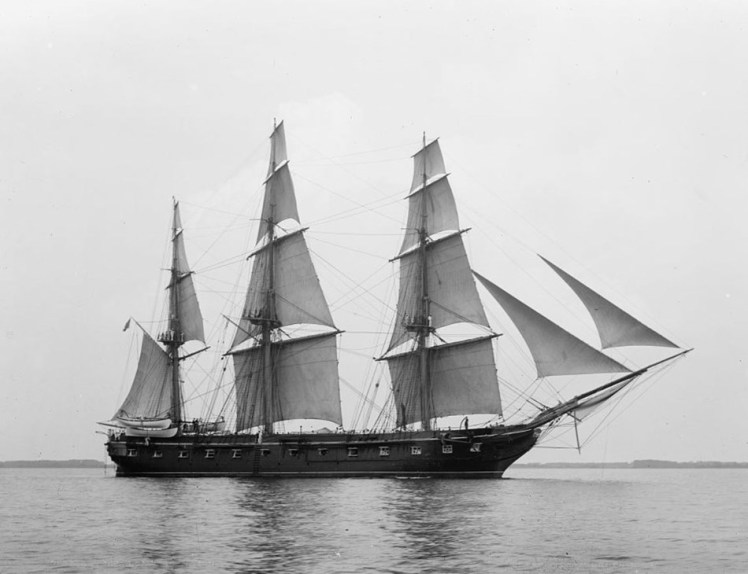
Constellation in 1890. Library of Congress Photo
The inception of a new battlecruiser named Constellation in 1917 resulted in her name being changed to Old Constellation, but when plans for the cruiser were scrapped, her name reverted to Constellation again. In 1920 when the Navy ceased training sailors to handle rigging and sails, activity aboard stopped and she was again towed, only this time to Philadelphia to participate in the 150th anniversary of the Declaration of Independence. There she was drydocked and hauled back to Newport Navy Yard in Rhode Island. She sat there until 1933 when the Navy decided to decommission her for preservation. Cost estimates were done and plans were made to restore her, but no work was ever begun. In 1940 she was re-commissioned as part of a pre-WWII buildup and given hull number IX-20. She was the reserve flagship for the Commander and Chief of the Atlantic Fleet, Admiral King. He was replaced by Vice Admiral Ingersoll who was on her for 6 months in 1942 and again from 1943-1944. In 1946 the Navy made plans to turn her into a memorial for the city of Boston but the lacked the funding and in 1955 she was stricken from the naval register altogether and towed to Baltimore. Once there she was drydocked and extensive repairs were done.


Left – in drydock in Boston Harbor to assess the cost of repair and turning her into a museum. Top right – the decommissioning ceremony. Bottom left – sailing her to Baltimore on a floating drydock.
Given berth at Baltimore’s Inner Harbor in 1961, she became a National Historic Landmark in 1963 and by 1966 was placed on the National Register of Historic Places. She is the only intact naval vessel from the Civil War era. Extensive repairs were done again the 1990’s and again in 2012. In 1994, she was declared to be unsafe by the navy and was literally sinking. Listing in her berth, she was drydocked in 1996 and at the cost of 9 million, more extensive repairs were made. The keel was warped and in an attempt to protect the wooden planking, the hull was wrapped in fiberglass and she was finally returned to her berth at the harbor in 1999. In 2004, she was towed from the harbor to Annapolis – her first trip there in over 111 years. More repairs were made to the hull in 2014 to replace rotted wood behind the fiberglass part of the hull. Completed rigging was added in 2015.


Left – in 1926 in Newport; Right – 1947 post WWII repairs.
Controversy
While there is now plenty of proof that the 1797 and the 1854 Constellations are in fact two different ships, the reasoning behind the Navy’s subterfuge of maintaining the Constellation’s register (she was never officially struck from the navy register in 1853), was to operate under the guise of repairs, thereby eliminating the need to apply to Congress for funds and approval to build an completely new ship. I find it hysterical that the Navy felt it necessary to circumnavigate Congress in 1853, which tells me that literally nothing has changed in 160+ years with regards to getting Congress to approve anything. I also find it hysterical that the Navy had to think outside the box 160 years ago in order to get things done that would otherwise have taken forever or possibly never have been accomplished at all. Sounds like the Navy had a superb plan to me. And in a way it was a very frugal plan. The Navy needed a new ship, the old one was in bad shape, they dismantled the older one while building the new, slap the same name on it, use some of the same timbers, made sure they look enough alike (to the untrained eye) so as to be confused one with the other, and if a muck-edy-muck from Congress happens to inquire about the busy shipyard? Oh – we’re simply repairing and modifying the old ship. Again. No funding was needed because everything on the new ship came from stock already at the shipyard. Now go away Mr. Congressman and let us build a new fix our ship. By 1853, slavery had become an explosive issue in Congress anyway, along with its expansion into the newly created territories, so odds are Congress wasn’t going to take the time to discuss funding for a new naval ship. Especially a wooden hulled, wind powered one considering that iron-clad steamers were becoming the new technology by that point.
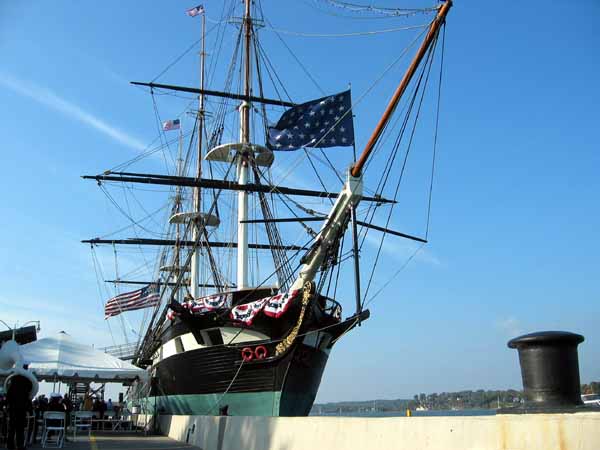
At the Naval Academy dock on the Severn River in 2004.
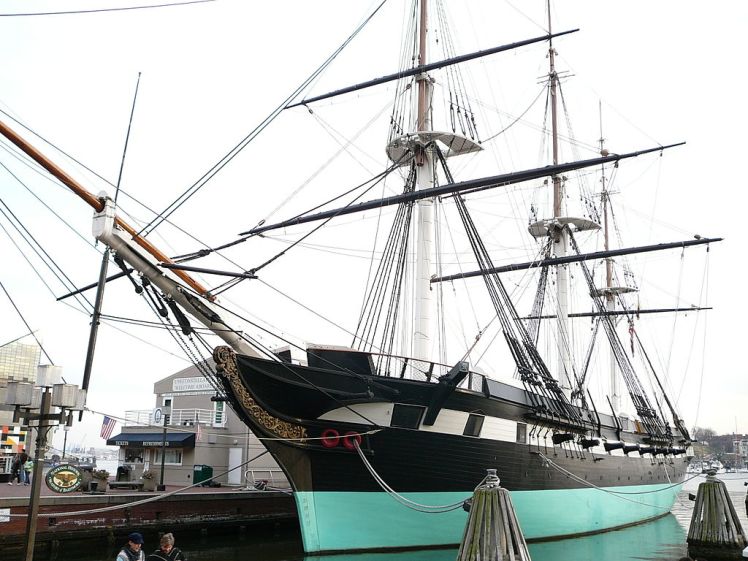
Fitted with new rigging. She really is a beautiful old ship. She makes an annual “turn-about” cruise now; she is guided by tug out of her berth and taken over to Fort McHenry where she salutes the fort with gunfire, and the fort acknowledges her by returning fire. She turns around and returns to her berth with opposite orientation. This is done yearly so that the hull weathers evenly.
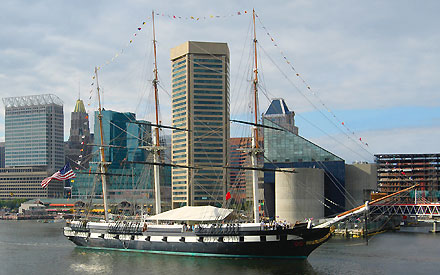
Moving past the aquarium during her annual turn-about.
Sources:
~http://welcometobaltimorehon.com/part-2-warship-constellation-launched-from-harris-creek-1797; History of Canton, Part 2: Warship Constellation Launched from Harris Creek, 1797 by Rafael Alvarez
~https://www.nps.gov/thingstodo/board-the-uss-constellation.htm
~http://www.historicships.org/constellation.html
~wikipedia.com
~https://explore.baltimoreheritage.org/items/show/188; Harris Creek, by Eli Pousson
~https://www.cecildaily.com/our_cecil/baltimore-ship-has-long-debated-history/article_ce273ebf-ec67-5244-9631-a19dc76dcdab.html; Baltimore Ship Has Long Debated History; by Erika Quesenbery Sturgill, Special to The Whig, Sept 23, 2017
~Findagrave.com – Memorial to Col. David Stodder (103828056)
~https://www.militaryfactory.com/ships/detail.asp?ship_id=uss-constellation-1797-frigate-warship; Staff Writer, 2016.
~https://mht.maryland.gov/secure/medusa/PDF/NR_PDFs/NR-20.pdf
~https://www.battleofbaltimore.org/items/show/323#.XbttuuhKjA8
~World Of A Slave: Encyclopedia of The Material Lives of Slaves in the United States; by Martha B. Katz-Hyman and Kym S. Rice, Editors; Copyright 2011.
~http://www.navsource.org/archives/09/46/46020.htm
 Baltimore Through My Eyes