I talked about our flag in one of my Civil War posts but I’m going to gripe about it again because everyone seems to think that it contains some mysterious Confederate symbol – and I want to assure folks that it does not. While there is certainly a bit of Confederate history, pro-Confederate Marylanders did not use the Crossland Arms as their “unofficial state flag.” The flag did not exist as we know it today and the coat of arms on the seal was incorrect color wise – that is, not red and white.
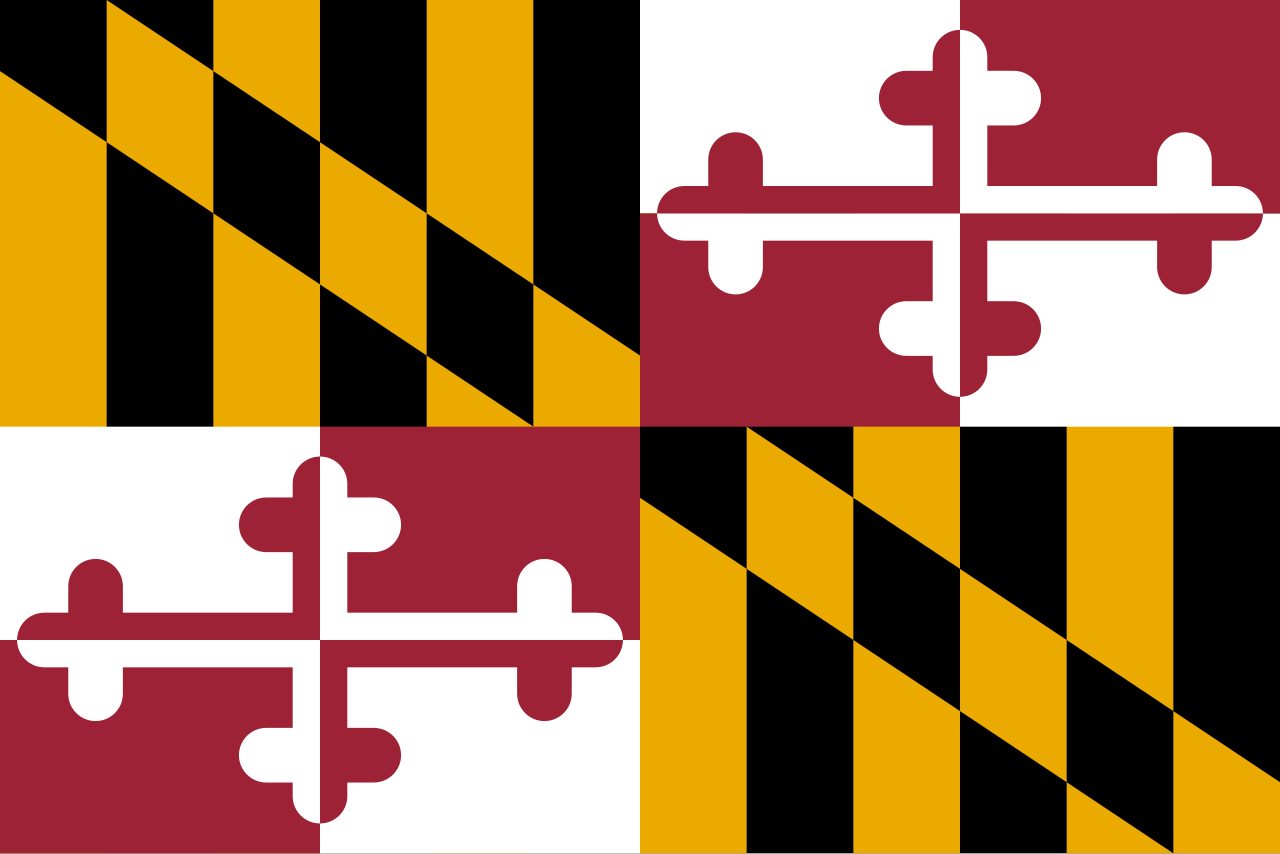
The Maryland State Flag is first and foremost, a 17th Century COAT OF ARMS. How accurate it is, per the rules of heraldry remains to be seen. Did the Calvert’s simply make it up? Read on.
A coat of arms is a heraldic device or design (as in heraldry) on an escutcheon or a shield. The shield forms only the center portion of the entire coat of arms or heraldic achievement. There are supporters, usually animals on either side of the shield; a crest on top of the shield, normally a helmet or crown of some sort, and finally a motto.
A coat of arms is always exclusive to the armiger. What’s that? An arminger is a person, state, organization, school, or corporation. The term originates from the design on the “surcoat” worn by knight and lords over their chainmaile armor. It is how knights and other nobility were identified on the battlefield. Coats of arms would be granted by the king or queen to an individual and depending on the grant, they could be passed down through the family usually to the eldest son, provided the family was armigerous. Notice I said “could be”. In some cases? They weren’t. They were bestowed on one person and were not passed down.
If there was no son in an armigerous family, then the eldest daughter claimed the arms and HER son had the right to “quarter” his father’s arms with his mother’s arms. This is precisely what happened with the arms that make up our Maryland Flag. Nobody simply decided to join the arms (unless you count Cecil Calvert) and it is NOT symbolic of the reunion of anybody after the damn Civil War – it just is a coat of arms. Period. The original arms? May not be all that legal – as per the Garter Principal King of Arms. (the dude with heraldic authority over England, Wales and Northern Ireland – since 1415)
Cecil Calvert, 2nd Baron Baltimore, was the son of George Calvert, 1st Baron Baltimore (1580-1632). George was very interested in the colonization of the Americas and after founding a place he named Avalon, located off the coat of Newfoundland in present day Canada, he moved further south, turned off by the cold climate in that region. After sailing to Jamestown and being met with a rather cold reception because of his religion, the area he finally settled on was to become Maryland. He died just weeks before the charter could be signed by the king, leaving the settlement of the colony to his oldest son, Cecil.
George’s parents were Sir Leonard Calvert, a gentleman from Yorkshire and Alicia Crosland, the heiress of John Crosland of Helmsley. Being an heiress would give George the right to “quarter” his arms, so to speak. In other words, divide the arms into quarters – i.e. four sections. His father’s arms in the 1st and fourth quarters and his mother’s arms in the 2nd and 3rd. While George’s parentage is a bit sketchy, the coat of arms is correct if, as stated, his mother was indeed an heiress.
However, while most agree that Alicia was a Crosland from West Riding Yorkshire, her name is only supported by traditional and oral history, rather than actual historical documentation. If you believe some of the genealogical websites, Alicia was born on August 20, 1552 and was the eldest child of a John Crosland of Crosland Hill and Alice Hawksbury. There were at least 7 other children, 3 girls (Lucy, Susannah and Ann) and 4 boys (George, Michael, John II and Luke). There is documentation of the deaths of Michael and Luke at very young ages. George and John II have birthdates but no death dates. If they died young as the other boys did, then that would in fact leave Alicia as the heir of her father. However, what we don’t know is if the family was armigerous. The only documented Crosland/Crossland arms there are, were given to Sir John de Crosland in the 14th century – he was born about 1370.
What has been documented is the fact that George’s mother died on November 28, 1587, while he was still a child, somewhere around 7 or 8 years old. His father re-married a woman named Grace Crosland of Crosland Hill. Grace is either the niece or cousin of Alicia, however, this fact is clear as mud as well. Because Alicia’s family is questionable, she was supposedly the heiress of John Crosland, and the fact that George did not quarter his arms, indicates that perhaps she wasn’t an heiress at all. Grace’s family is known and she had brothers so, she was not an heiress and she was NOT George’s mother. She was supposedly the daughter of Thomas Crosland, John Crosland’s brother.
More things to muddy the water…
Despite being the son of a gentleman, George Calvert was not born a nobleman and his father’s family was certainly not armigerous, which means that without a doubt, he was NOT entitled to any sort of authorized coat of arms at birth. Calvert’s family were nonconformist Catholics who apparently found themselves repeatedly in trouble with the English government and church, which had been doing its utmost to stamp out Catholicism since the dissolution of the monasteries began in 1536 under Henry VIII. George converted to Anglicanism in 1593, after the family ran afoul of Elizabethan religious laws. He attended Oxford, rose at court, was knighted in 1617 and began his career working for Sir Robert Cecil. He eventually became Secretary of State in 1619. He was finally granted his very own coat of arms in 1622 (the black and gold) because of his service to England. By 1623, King James VI/I had also granted him a 2300 acre estate in Leinster, County Longford called…… The Manor of Baltimore. Irish – Baile an Tí Mhóir. By 1624, George had resigned his position at court and converted back to Catholicism. All of the religious back and forth is most likely the reason he founded Maryland as a refuge for English and Irish Catholics. Despite this, James finally appointed him – Baron Baltimore. Now with a title and finally armigerous, his coat of arms got passed along to his son, Cecil. George’s wife was a woman named Anne Mynne. Her family was armigerous and while she wasn’t an heiress, her family arms were split with her husband’s once he was elevated to the rank of peer.
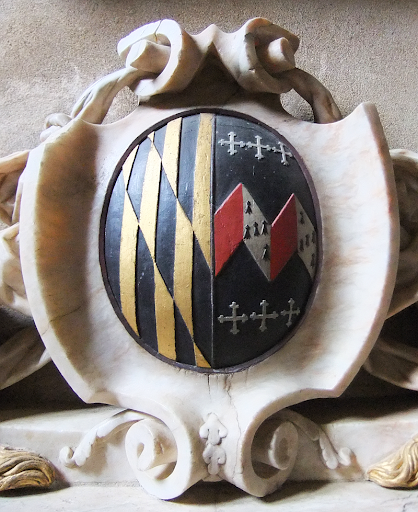
Anne’s father’s arms split with George’s on her tomb at St. Mary’s Church, Hertingfordbury, England. There are some striking similarities between her arms and the Crossland arms – the white/silver bottony crosses and the red and ermine on the bar dancetty (the zig-zag). Could this be what Cecil Calvert based the “Crossland” section of his arms on? The colors fit anyway.
“The Annotated Code of Maryland provides: “(a) The State flag is divided into quarters. (b) The first and fourth quarters are a paly of six pieces, or (gold) and sable (black), and a bend dexter (right diagonal band) counterchanged, so that they consist of six alternating gold and black vertical bars with a diagonal band on which the colors are reversed. (c) The second and third quarters are quartered argent (white) and gules (red), a cross bottony counterchanged, so that they consist of a quartered field of white and red, charged with a Greek cross that has arms terminating in trefoils and opposite coloring so that red is on the white quarters and white is on the red quarters, as represented on the escutcheon of the State seal.”
Technically, per the rules of heraldry – part of this description is wrong wrong wrong – or means gold, sable means black – that part is correct. The color yellow represents or/gold. Argent means SILVER not white, gules mean red. The Crossland arms are SILVER and red – not white and red. White simply represents argent/silver. That’s the rules, I didn’t make them up.
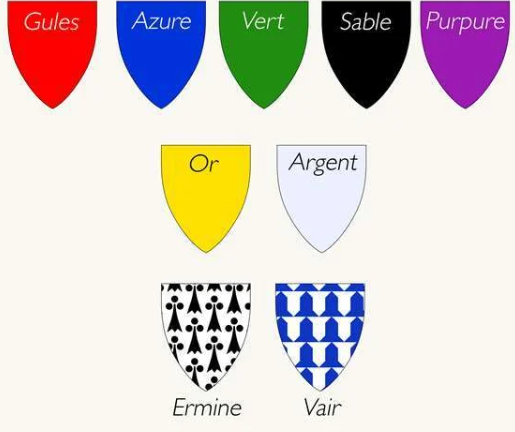
For reference – the heraldic colors are as follows: Red = Gules, Blue = Azure, Green = Vert, Black = Sable, and Purple = Purpure. The two ‘metals’ are: Gold/yellow = Or and Silver/white = Argent. The furs are as follows: Ermine: representing the white winter fur of stoats, with their black tail tips and Vair: representing squirrel skins, in blue and white. If something is shown in its natural colors, it’s called proper.
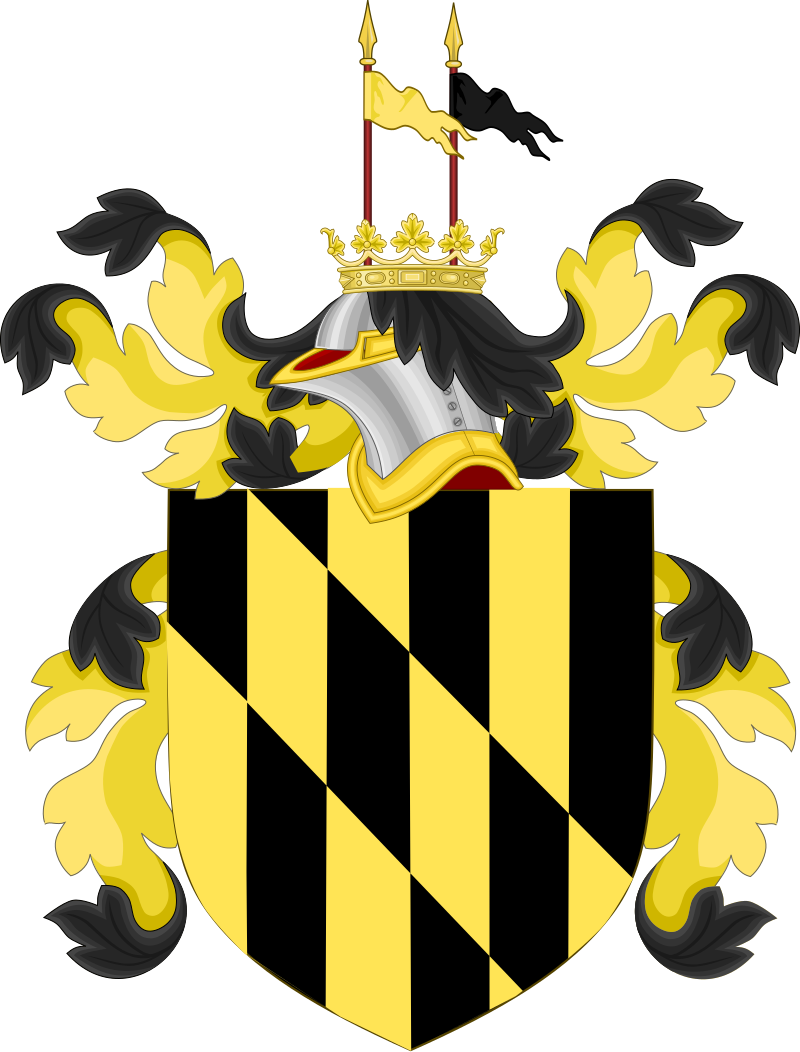
George Calvert’s arms as granted by King James and the Garter Principal King of Arms. These are correct – as per the rules of heraldry.
The Actual Crossland Arms
There are no Crossland Arms. That’s according to Burke’s General Armory. The arms that do exist are Crosland Arms. I know I’m being nit-picky, however……this is The General Armory of England, Scotland, Ireland and Wales. Comprising a Registry of Armorial Bearings from the Earliest to the Present Time. Written by Sir Bernard Burke, C. B., L.L.S., Ulster King of Arms. It’s a three volume set and I just happen to have a well-thumbed copy. It documents some 60,000 coats of arms.
It states as follows – Crosland – (Crosland Hill, County York – Visit. 1665) – Quarterly argent and gules, a cross botonee counterchanged. In other words – the red and white (silver) quarters of our flag. The “visit 1665” simply means that county York was visited by a herald that year. Crosland Hill is in Almondbury. It doesn’t state who these arms belong to – they are NOT family arms. There is no such thing. They were granted to someone – male.
Just to make things difficult, there is another set of Crosland arms. These were granted to John Woodhead Crosland, Esq. of Thornton Lodge, County York. This John was born in 1860. They are – Same arms, a crescent for difference; quartering or, five cinquefoils in saltire gules. Crest – a cross flory gules and argent. Motto – Ultra Pergere. In other words. quartered arms with the first set of Crosland arms in the 1st and 4th quarters with a crescent for difference (a mark of cadency indicating a 2nd son) and in the 2nd and 3rd quarters a gold field with 5 red flowers with 5 petals/leaves.
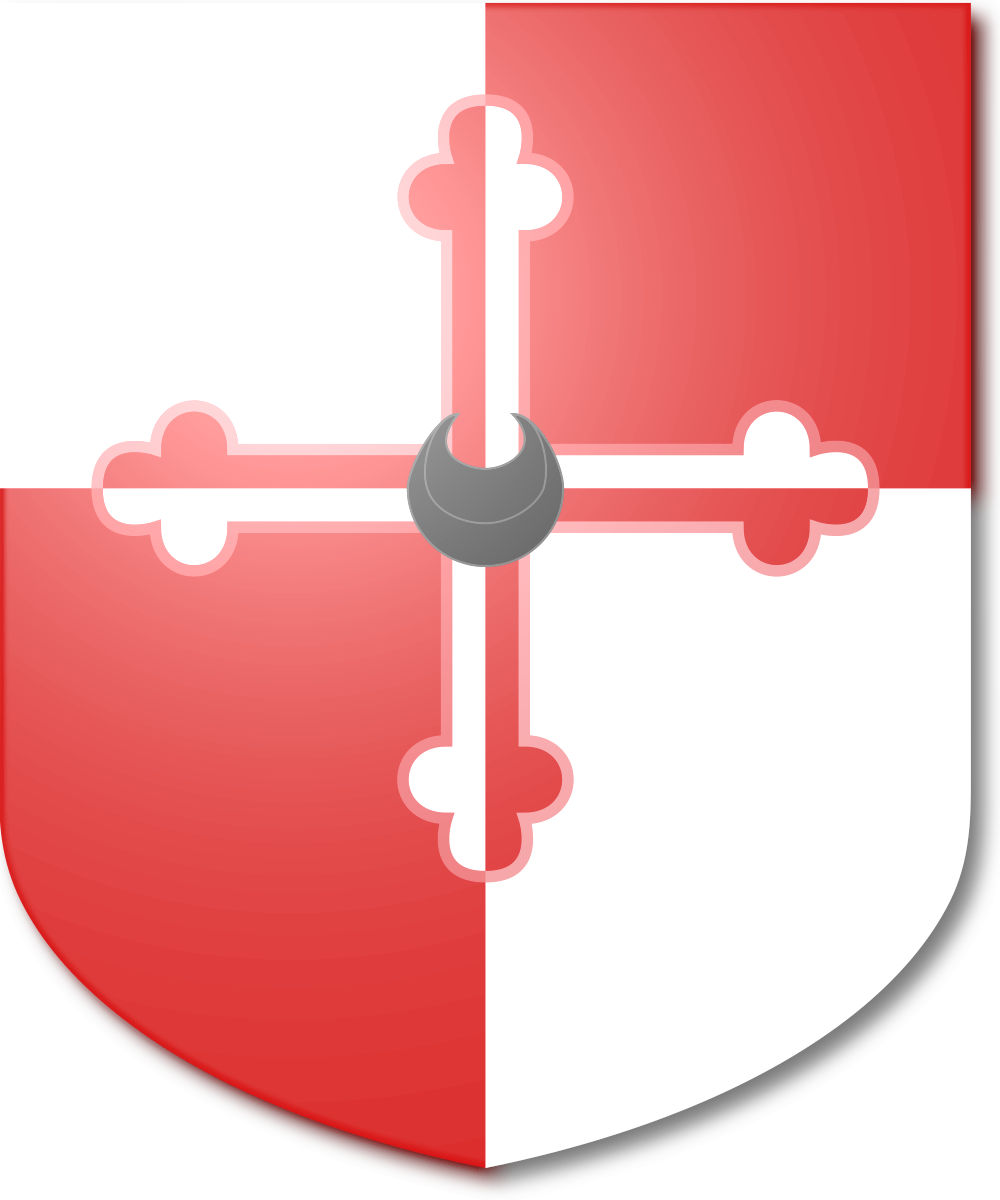
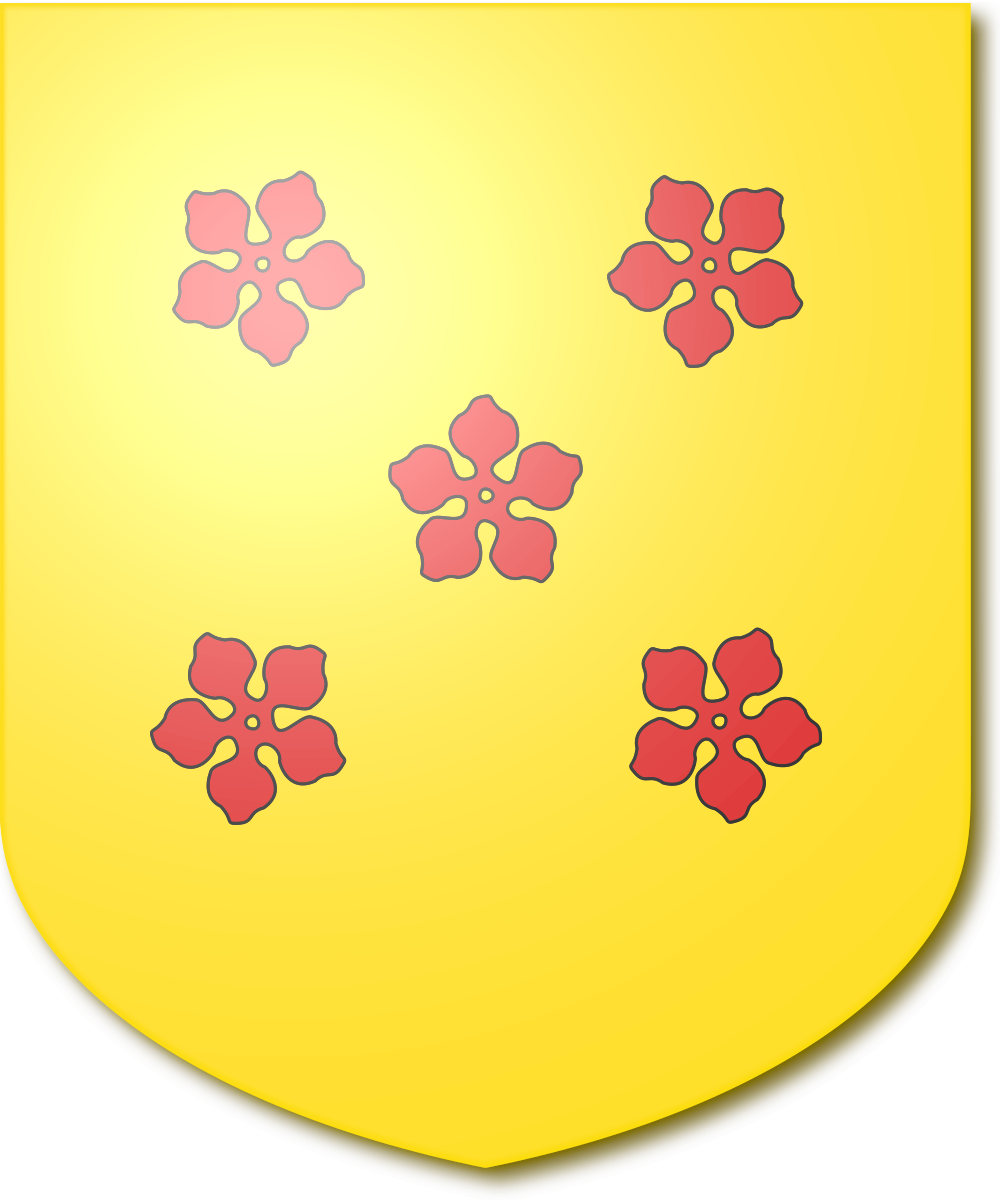
These are the quarterings of the second set of Crosland arms. Left – 1st and 4th quarters; Right – 2nd and 3rd quarters. I I created these online by entering the blazon at Drawshield.net.
The Beginning of the Flag
During the colonial period, the only banners and flags associated with Maryland were banners containing the black and gold portion of the Calvert Arms. It is these arms that still represent the city of Baltimore, with the addition of Battle Monument in the center of the flag.
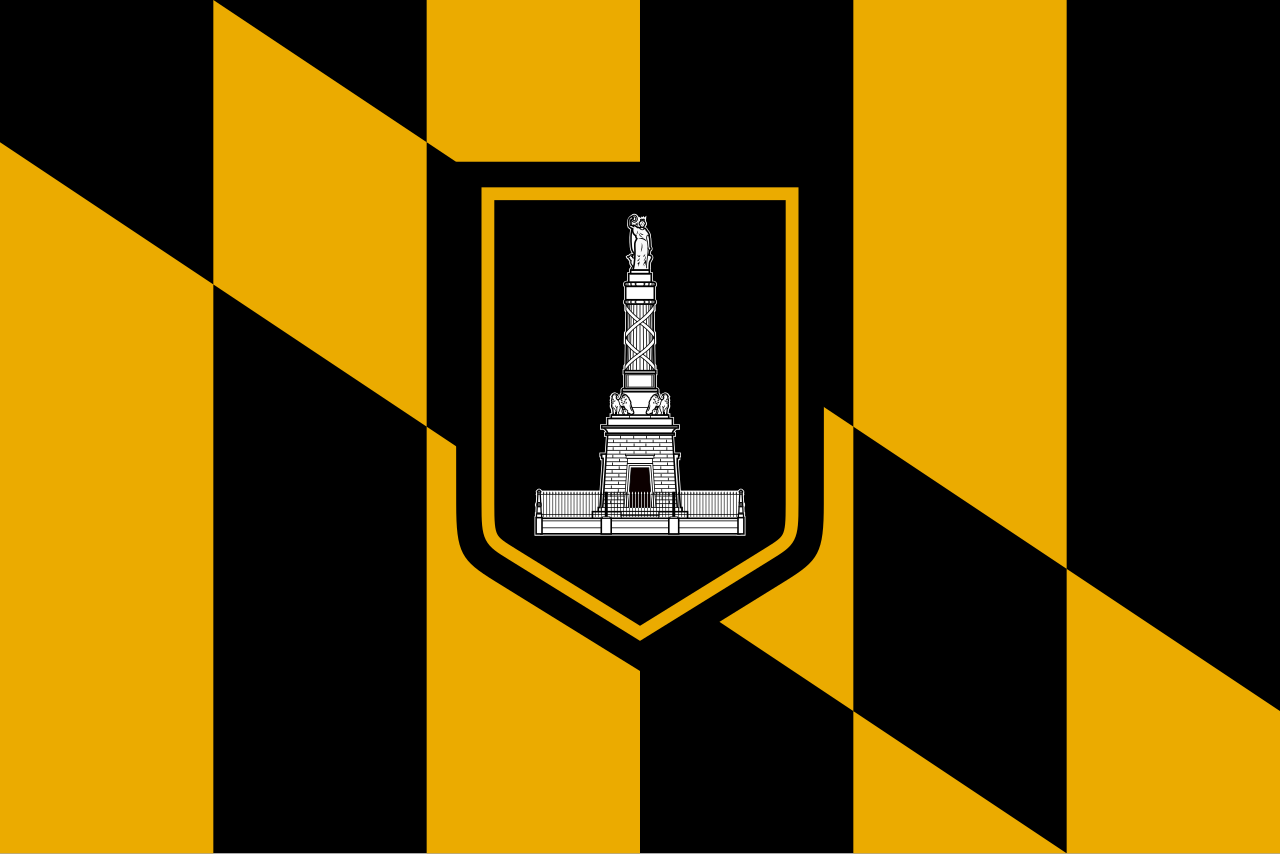
Baltimore City’s flag. Adopted in 1915, prior to that it was much that same as Maryland’s – the city seal on a blue background.
After the Revolution, up until about 1854, the only banners, or flags representing Maryland were the state seal on a blue background. It is interesting to note that prior to 1854, none of the state seals depicted the coat of arms. There were several versions of the seal beginning in 1645 when Maryland was a colony. One was even stolen and Cecil Calvert had to replace it.
Apparently when conducting business in England, the Calvert’s used the black and gold arms only, but when conducting business as the “True and Absolute Lords and Proprietaries” of Maryland – the Crossland arms were added. They had to know that if they used the Crossland arms in England that they would eventually get caught and fined and possibly have the ability to use them at all removed. In the colonies, they were large and in charge and most likely knew the arms wouldn’t have been questioned. So they did. As it stands, Cecil Calvert, the 2nd Baron, is the first Calvert to quarter the arms. His father, George, did not. The quartered arms were used as early as 1635 on official colonial documents.
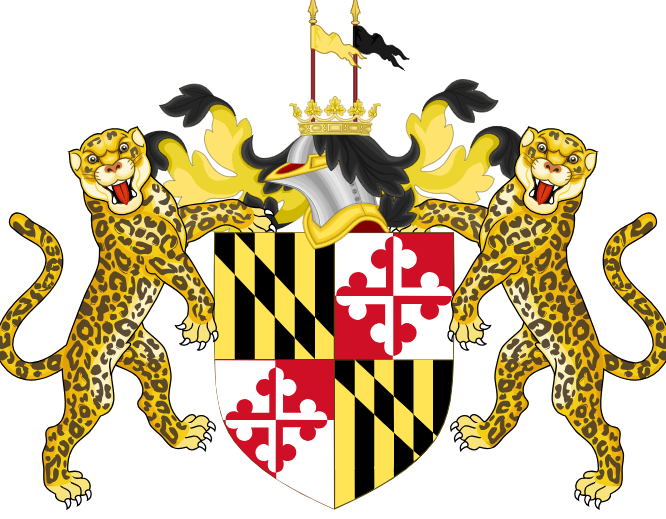
Cecil Calvert’s Coat of Arms, with the quartered arms, leopard supporters and helmet and crown crest.
The Civil War
It is the Maryland Seal that was used from 1854 until 1874 that contained the coat of arms that would eventually become our flag. The flag itself didn’t officially exist until 1904. It is this coat of arms, not the flag, that some claim inspired the use of the Crossland arms as the symbol of the Confederacy in Maryland. However……… the coat of arms on the seal? Was done incorrectly. So I very seriously doubt that could be even remoted used as an argument. The Paly of 6 in black and gold, suddenly became a Paly of 5, and the cross bottony? Was done in black and silver, instead of red and silver. It was eventually corrected, but not until 1876, years after the war after the Crossland arms were actually investigated. The result of this was that Maryland’s unofficial flag looked very much like Viriginia’s flag.

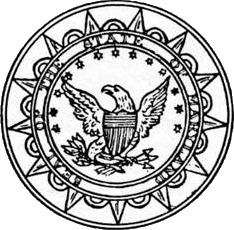
The Seal on the left is dated from 1794 to 1817 – the Seal on the right is dated from 1817 to 1854.
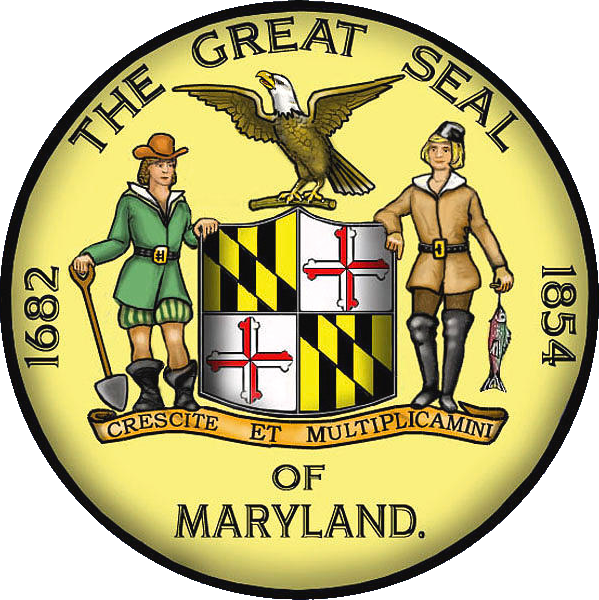
This Seal is the 1854-1874 Seal with a sort-of correction made to the Crossland Arms. They are however, still incorrect.
Red and white comprised part of the original Confederate flag (there were three official flags – and no the battle flag is not one of them), so it stands to reason that those colors would have been used by southern sympathizers in Maryland and elsewhere in the south to show their support for the Confederacy.
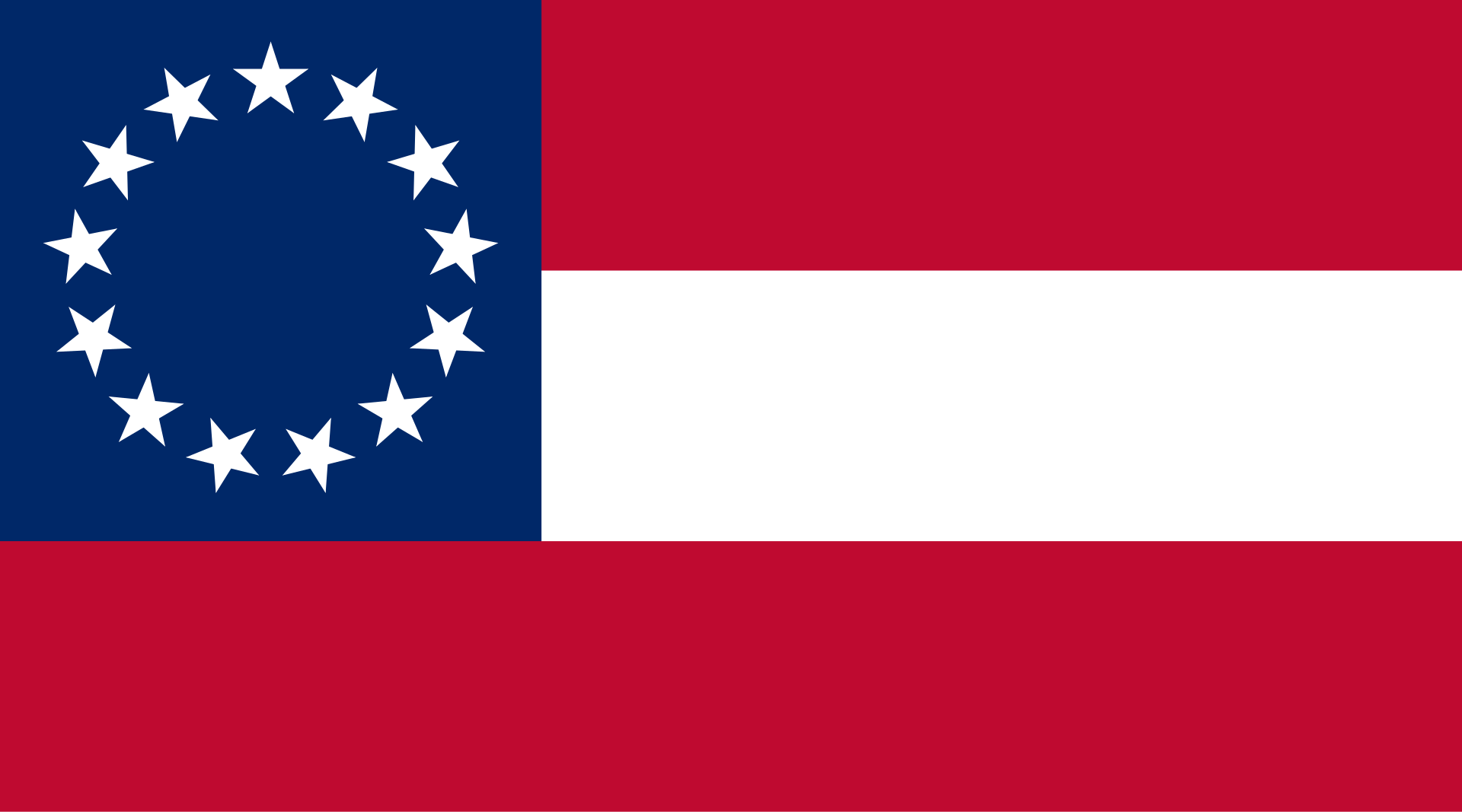
The first official Confederate flag – known as the “Stars and Bars” – it was decided to be too much like the American Flag and redesigned in 1863. In the meantime, the Confederate Army used the Battle Flag – the square flag most associated with the Army of Northern Virginia. In May, 1863 the flag was officially changed to the “Stainless Banner” and when that looked too much like a surrender flag? A red stripe was added and it became the “Blood Stained Banner”.
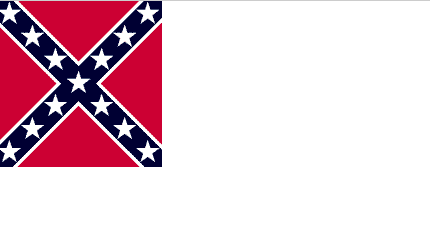
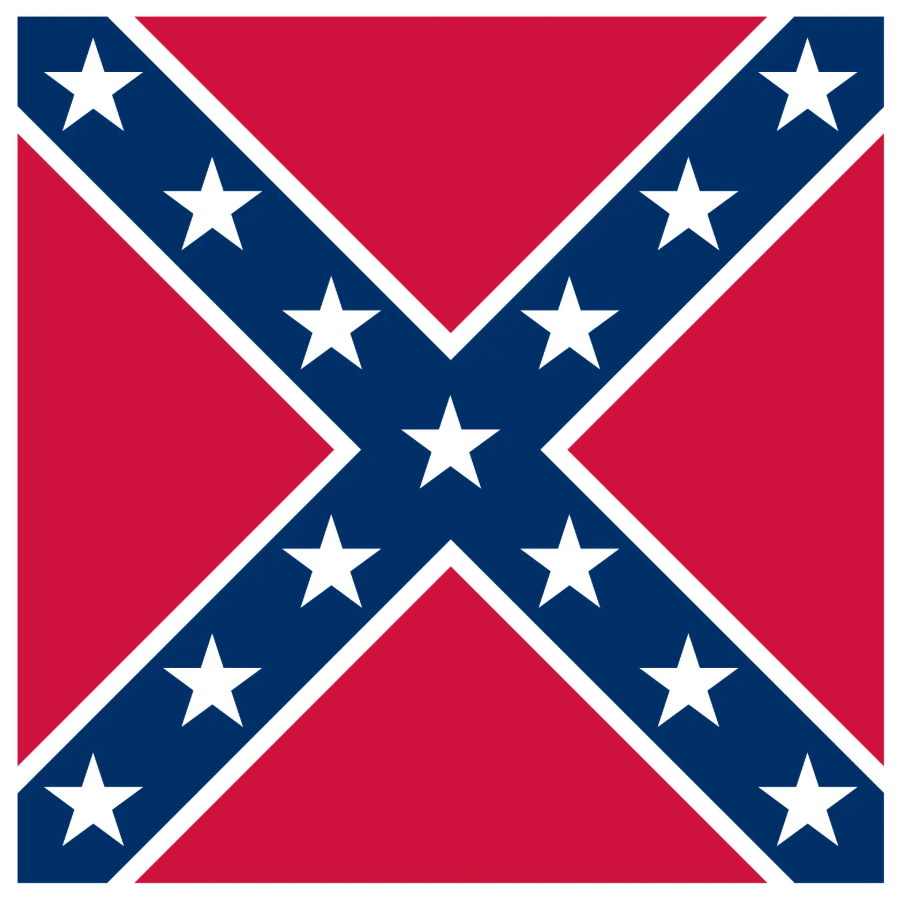
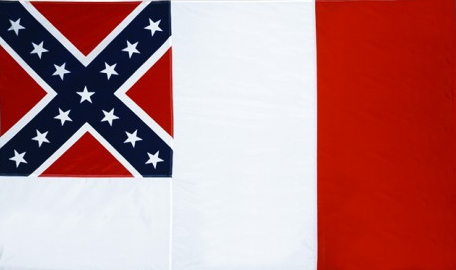
The Stainless Banner, the Battle Flag and the Blood Stained Banner – one can see where red and white are part of the imagery here.
“The military authorities of Baltimore city have interdicted the wearing of “red, white and red” emblems. All stockings, cravats, handkerchiefs, aprons, reticules, ribbons, breast-pins or other devices bearing the Confederate colors are forbidden to be worn by men, women, boys, girls or babies.” The Daily Exchange, September 1861.
In other words, you can’t do it. You’ll get in deep doo-doo if you do. Red petticoats on ladies were also a non-no, as was whistling “Dixie”. General Benjamin Butler, after he occupied Baltimore in May 1861, issued a proclamation stating that “No flag, banner, ensign or device of the so-called Confederate States, or any of them, will be permitted to be raised or shown in this department, and the exhibition of either of them by evil-disposed persons will be deemed and taken to be evidence of a design to afford aid and comfort to the enemies of the country.” Even Confederate music and envelopes were removed from shop windows.
Notice how the “red-white-red” combo is referred to as Confederate colors, not Crossland colors or Maryland Secessionist colors. Just plain old – Confederate colors. Women and children were arrested and hauled into jail in Baltimore for wearing these colors. Why? Lincoln had declared martial law in Baltimore because it sat north of Washington D.C. Red and white appeared in scarves, feather cockades on hats, fans, hair ribbons, socks, cravats, purses, and aprons. I think it’s fairly safe to say that red and white was seen in Maryland as Confederate colors and not, as some speculate, as simply the opposite of the black and gold Calvert arms and used in anger by Pro-Confederate Marylanders against the Maryland state government because it made the very intelligent decision not to secede from the Union. In fact, during the Baltimore Riots in 1861 (see my blog posts about that), the pro-Confederate folks who were attacking the Union troops desperately trying to work their way across Pratt Street to Camden Station, whipped out black and gold banners. So if one were to argue the point? The entire flag has been picked apart and used as pro-Confederate banners at some point, but BEFORE it was actually our flag. So…….
Secession flags were flown from windows and subsequently confiscated but they were actually the “Stars and Bars” and the “Palmetto Flag” of South Carolina simply because it the first state to leave the Union.
Another sticking point would be the flag flown by the 2nd Maryland Infantry, CSA. It contains the Maryland Seal, but as the colors of the Crossland arms were still unknown, and the seal was incorrect, they are depicted on this particular flag as being blue and red. Which is incorrect as well. In each quartering on a coat of arms? Each escutcheon is a color next to a metal or fur. There is never, ever a color next to a color unless it is a quartering sitting next to another quartering. So the blue sitting next to the red in Crossland quart of the arms? Is wrong – but no one paid attention, most likely because no one knew or cared.
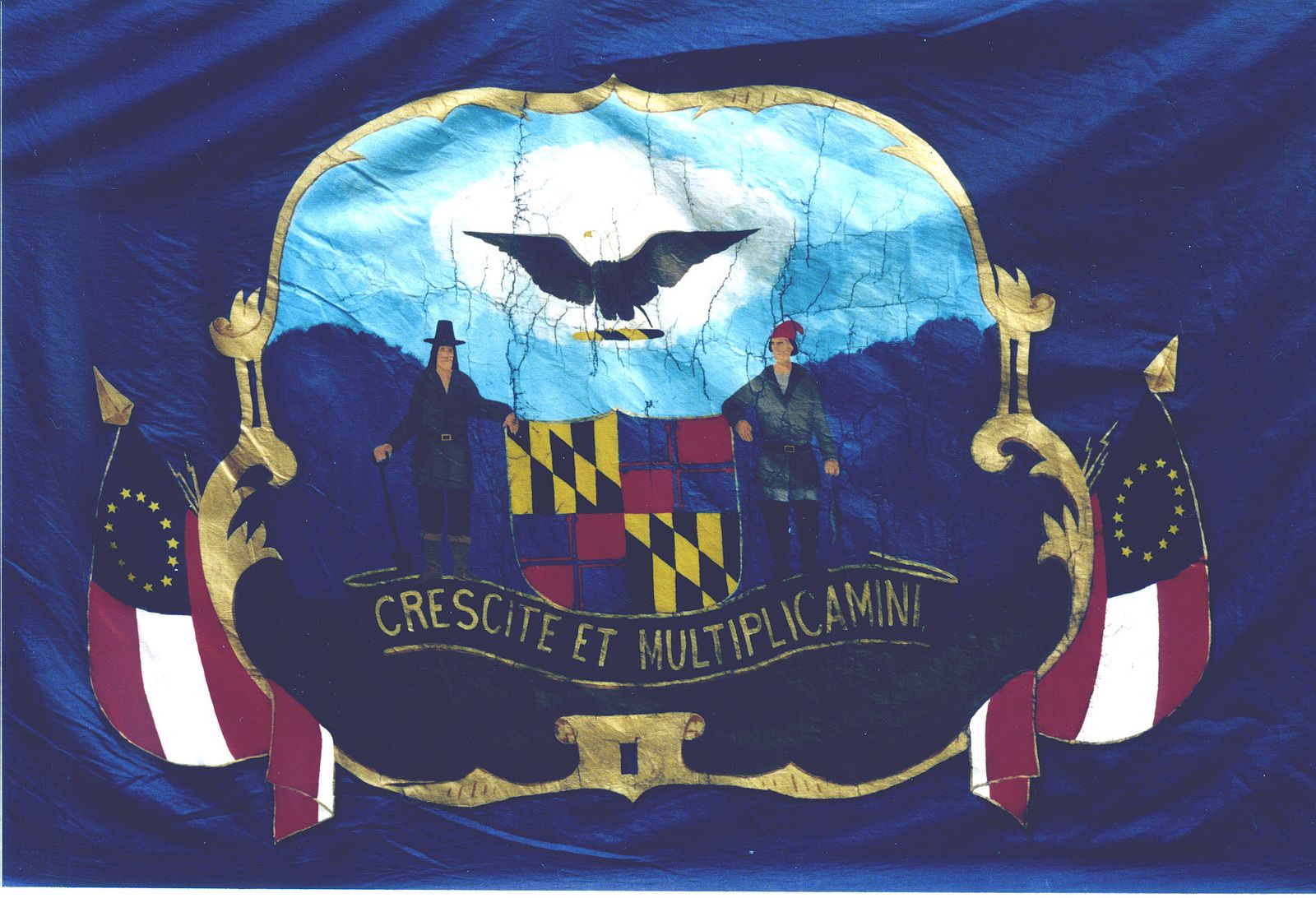
The flag used by the 2nd Maryland Infantry CSA – the entire seal is represented here, albeit, incorrectly.
That Durned Cross Bottony
The use of the cross bottony is interesting too, it was used during the war to designate Corp numbers as well as Division numbers. Color and shape of the badge generally told soldiers in an instant, what Corp and Division another soldier belonged to. As both armies began as the United States military? Insignia and color use was glaringly similar across both. For example – yellow trim, sashes and the like on uniforms indicated a cavalry soldier; red was artillery. General Bradley Johnson’s (the commander of the 1st Maryland Infantry, CSA) guidon (the swallow-tail flag) contained a red botany cross on a white background, as did the guidon for the 4th Maryland Artillery, CSA. What is a guidon? “A guidon is a military flag that a company/battery/troop or platoon-sized detachments carry to signify their unit designation and branch/corps affiliation or the title of the individual who carries it.” Basically, it bloody-well represents the unit and the commanding officer. Period.
There is a bottony cross on Johnson’s grave in Loudon Park Cemetery in Baltimore and on the monument to the 1st/2nd Maryland Infantry CSA at Gettysburg. It is Johnson’s Headquarters flag that perhaps perpetrated the myth that the Crossland arms were somehow representative of Maryland’s Pro-Confederate population. The only similarities between the guidon, the Confederate colors and the Crossland arms? Are the colors of red and white. In fact, Johnson stated just prior to the Baltimore Riot in April 1861, that Maryland was up in arms because Virginia had seceded. He states that the “Black and Gold” was being saluted and the American flags had been taken down, substituted with the “Stars and Bars” and the Blue flag containing the state seal. Wait??? The Crossland arms is red and white/silver.
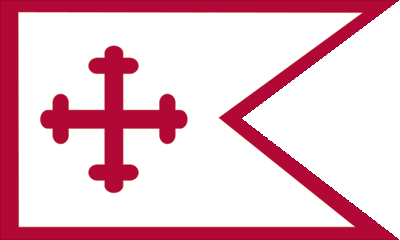
Digital representation of Johnson’s Guidon.
In the Union Army – the color red was representative of the 1st Division of Corps; white – the 2nd Division and blue the 3rd Division. Green and Yellow were utilized as well. Corps were broken down by symbols – so literally, a guy with a red cross bottony pinned to his uniform or hat? Was with the 1st Division, 18th Corps – The Army of the James. Corps badges were anything from acorns, stars and crescent moons, to circles, squares, clubs, diamonds and hearts. Oh and regular, crosses, Maltese crosses and bottony crosses.

Confederate troops from Maryland wore metal bottony crosses pinned to their uniform jackets to identify where they were from, much like Union troops with the colored patches on their hats and jackets. Artifacts have been found near Hanover Junction , VA, simply because that is where the Maryland Line Troops were camped during 1864. They were not colored patches and were not the Crossland arms because at this point in Maryland’s history, the flag didn’t exist and the state seal had the arms represented incorrectly as black and white. There are folks out there that have stated numerous times that Maryland Troops at Antietam flew the Crossland Banner – the only Confederate Maryland troops present at that battle were the artillery troops of the Baltimore Battery – the 2nd MD Artillery, flying the blue flag with the state seal.
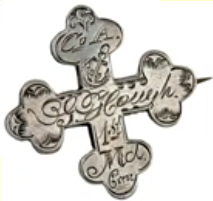
This pin belonged to Pvt. Gresham Hough, 1st MD Cavalry, CSA. There are at least 2-3 others that have been found, belonging to Cpt. William Dawson Brown, 4th MD Artillery (Chesapeake Battery) CSA, and Lt. William P. Zollinger, 1st (2nd) MD Infantry CSA.
There is absolutely zero record of Union Troops from Maryland wearing just the black and gold Calvert arms stitched to their uniforms, and the flags flown by those same troops also contained the Maryland Seal and the entire coat of arms as well.
The Flag is FINALLY created
The first flag that looks like Maryland’s current flag was flown in 1880 at a parade in Baltimore celebrating the founding of the city in 1730. At least that is what was reported anyway and there is a sketch of the parade and the flag. It then reappeared in Gettysburg in 1888 at the dedication of monuments to the Maryland Regiments that fought with the Union Army of the Potomac. It became our official state flag on March 9, 1904 when it was adopted by the Maryland General Assembly.
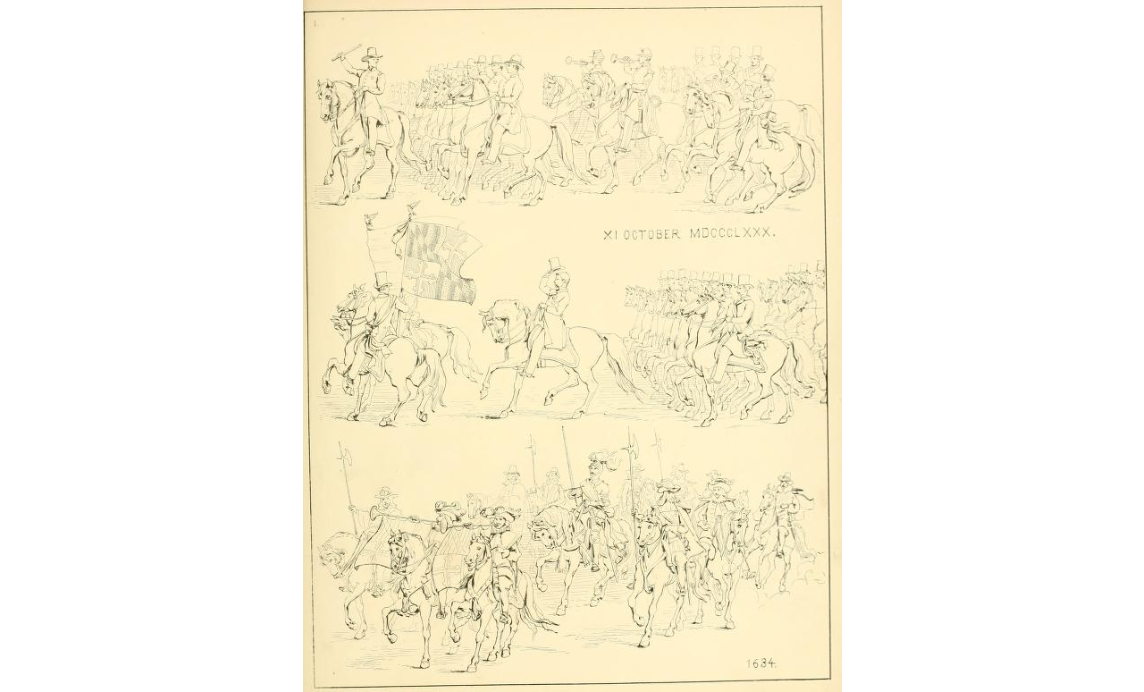
Drawing of the 1880 parade – taken from “An Account of the Municipal Celebration of the One Hundred and Fiftieth Anniversary of the Settlement of Baltimore Oct 11th – 19th 1880 ” by Edward B. Spencer. The drawing was done by Frank Mayer.
Just a side note – In 1994 I attended the dedication of the Maryland Monument at Gettysburg. It depicts two wounded soldiers, one has been shot in the arm, the other in the leg, helping each other off the battlefield. One is a Union soldier and the other Confederate. The only way you can tell is by their belt buckles. Gettysburg sits about 22 miles from the Mason-Dixon Line, i.e. the border with Maryland. Maryland sent troops from both sides into the war, and it was very obvious at Gettysburg where Maryland troops faced off against each other at Culp’s Hill. In a few cases it literally was brother against brother.
Union Troops
1st Eastern Shore Infantry, 1st Potomac Home Brigade Infantry, 3rd Infantry, 1st Calvary, Co. A Purnell Legion Cavalry, Battery A, 1st Artillery
Confederate Troops
2nd Infantry, 1st Cavalry , 1st Artillery, 2nd Artillery (Baltimore Light), 4th Artillery (Chesapeake)
Just for fun – the 1st Maryland Cavalry, CSA, had in its ranks my 2nd granduncles – James Edward Duvall (dad’s side) and William Henry Everngam Sr. (mom’s side) – their nieces would have grandchildren who would marry and have …..me. They likely knew each other. Born in Centreville on Maryland’s Eastern Shore, Everngam was captured on the retreat from Gettysburg at South Mountain near Hagerstown, shot in the thigh. He was sent to Fort McHenry and then to Fort Delaware where he died from dysentery on August 29, 1863. He is buried at Finn’s Point National Cemetery in Salem, NJ in an unmarked grave. He was 33 years old. His death made the Baltimore Sun because he was responsible for the sinking of the ship “Hard Times” in the Corsica River in Queen Anne’s County. The ship was caught smuggling guns to the south and was tied up under Union Guard at the Centreville Wharf, its Captain under arrest. Everngam and a buddy burned it and sank it.
From Baltimore City, DuVall had enlisted in November of 1862 and had come with his own horse valued at approximately $230.00. Must have been an impressive animal because that’s about $7200.00 in today’s money. He was present at Gettysburg and survived the battle and retreat only to be admitted into the hospital in Charlottsville in August. Returning to duty in September he was placed in charge of the disabled horses. His own horse died at Hanover Junction in January 1864 and he went for a new one. What should have taken 15 days ended with him deserting his unit at Harrisonburg, Virginia (home of the rest of my father’s family – the DeViers). He was finally captured at Bladensburg and sent to the Old Capitol Prison. Transferred to Elmira Prison, he applied for and took the oath of allegiance on New Year’s Eve, 1864. Released in February 1865, he was made to swear that he would never come south of Philadelphia unless in the service of the United States. He was 23 at the time and lived to be 61, dying in Philadelphia in 1903. What most likely saved him was the fact that his uncle (father’s older brother) had spent years in the USMC and the US Navy and was stationed at the Navy Yard in D.C.
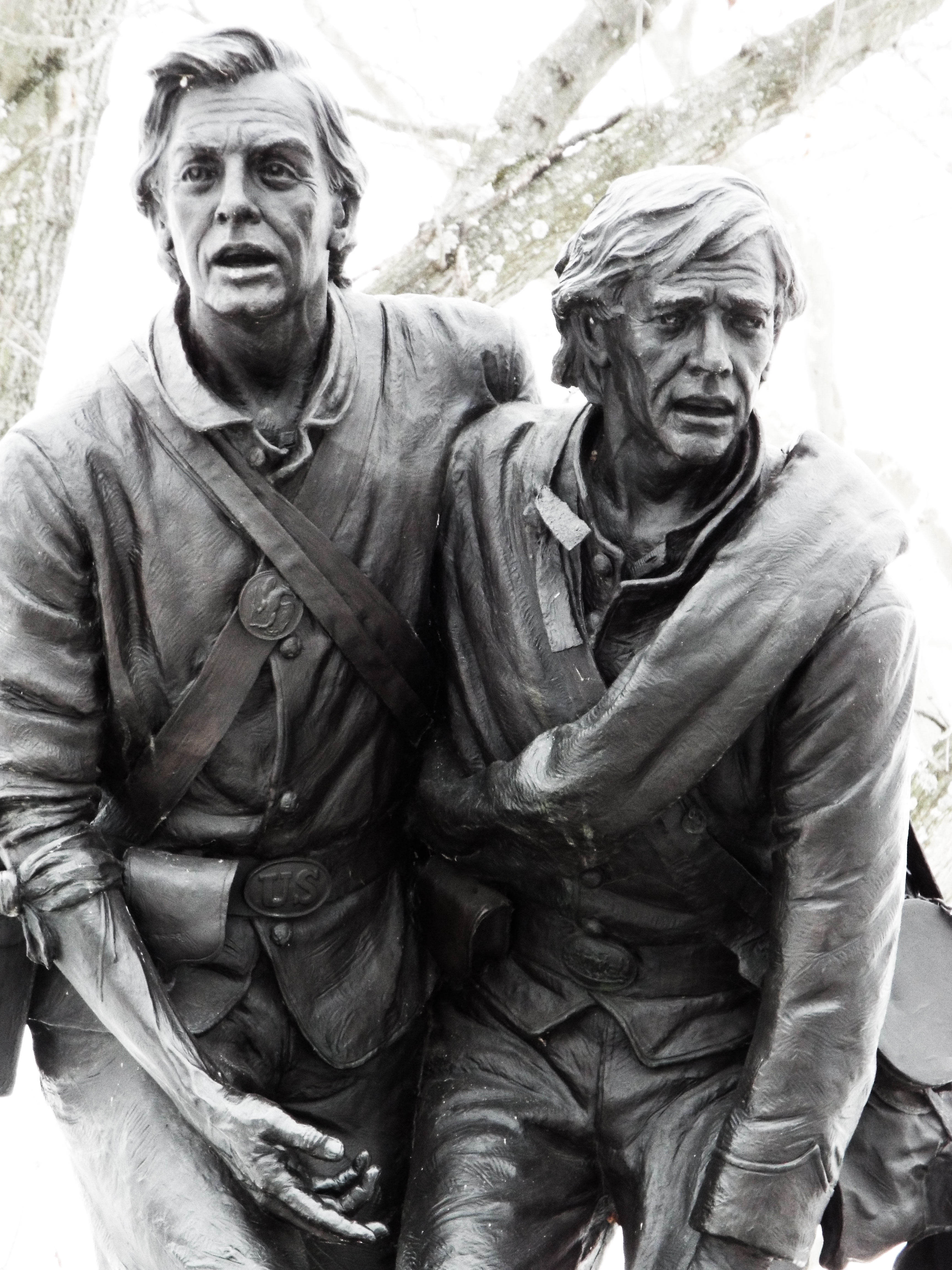
Photo I took of the Maryland Monument in February 2015.
Baltimore’s 5th Regiment
If you’re from Baltimore, surely you’ve heard of the 5th Regiment Armory which sits downtown by the state office building? It is owing to a member of 5th Regiment of Militia that the flag exists at all. Organized prior to the Civil War, most of its soldiers landed in the 1st Maryland Infantry CSA once the war started. After the war, it was re-organized and contained many ex-Confederate veterans. Known as the “Dandy Fifth” by supporters and “The Rebel Fifth” by those opposed, the 1867 reformed unit’s lineage includes the unit that fought in the war of 1812 and that of the 1st Maryland Infantry CSA. It is now the 175th Regiment Maryland National Guard which is part of the 29th Division of the US Army – known as “The Blue and The Gray”. Wonder why they call it the Blue and The Gray? That’s rhetorical.
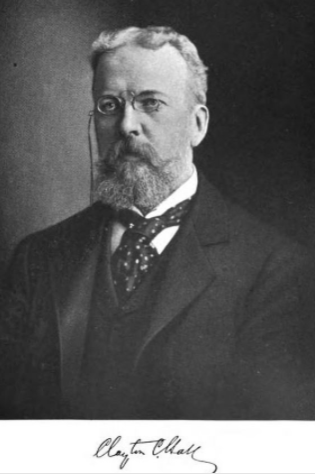
The former member of the 5th Regiment was a man named Clayton Coleman Hall. Born in 1847, Hall had been a Major in the 5th and was also a lawyer and a historian. He wrote books on Maryland’s history and Lord Baltimore and he served as the chairman of the Maryland Historical Society. He is the one that researched and corrected the Crossland arms on the seal, and as a result, he is responsible of the design of the current flag. It is his design that was adopted as the regimental flag of the 5th and displayed again in 1889 during a parade. Two local newspapers reported on it. It took 15 years for that design to finally become our official state flag, and while it does have a Confederate history of sorts, simply because of where Maryland is located, the fact that was a slave state, and the number of Confederate Veterans in the 5th Maryland. Despite all of this, I am so very proud to call it my flag.
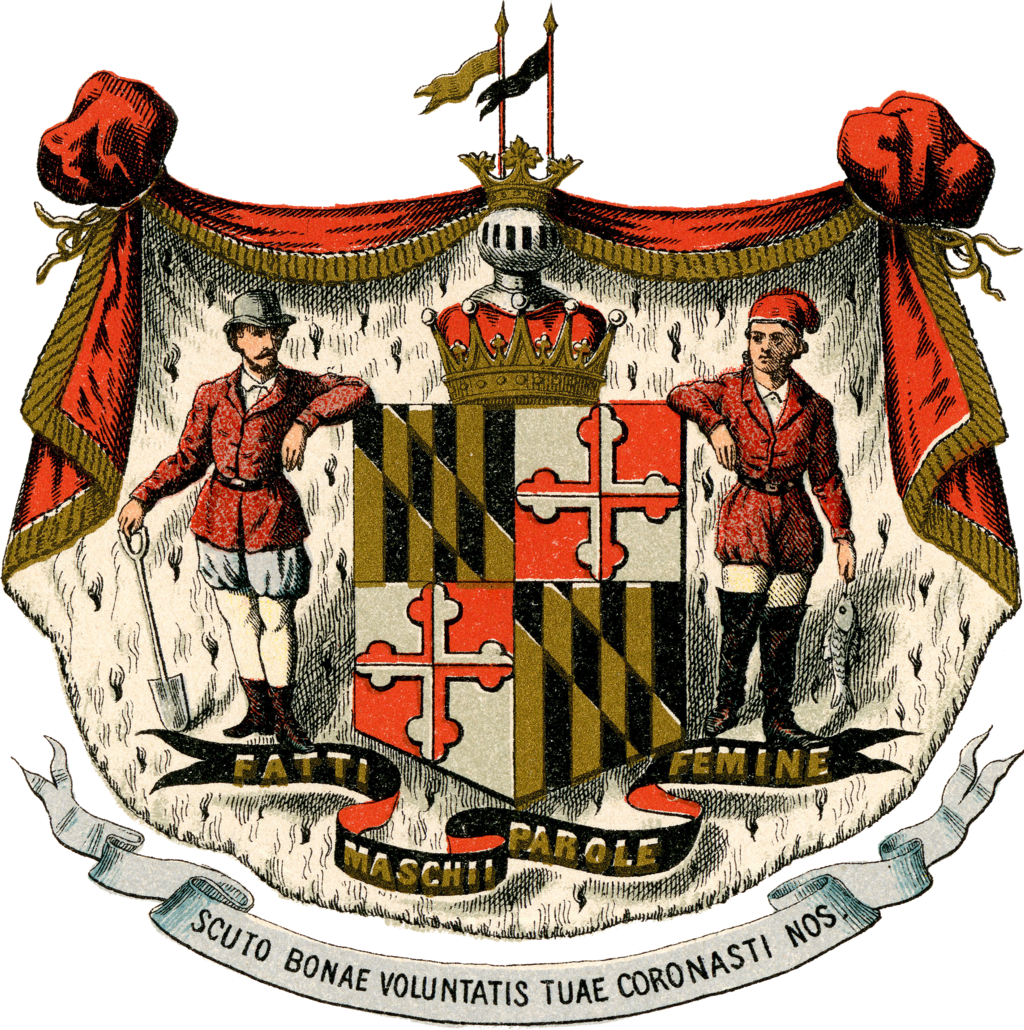
Maryland’s Historical Coat of Arms – done in 1876 – with the Crossland Arms finally correct.
Sources:
Image 345 of 1730. Memorial volume. 1880. An account of the municipal celebration of the one hundred and fiftieth anniversary of the settlement of Baltimore, October 11th-19th, 1880, with a sketch of the history, and summary of the resources, of the city. Library of Congress
Wikipedia
The Baltimore Sun – http://www.Newspapers.com
Letter from Major General John Dix to General George McLelland
http://www.Ironbrigader.com/2016/05/15/general-benjamin-butler-occupies-baltimore/
The Maryland Historical Society
The Maryland State Archives in Annapolis
http://www.english-heritage.org.uk/guide-to-heraldry
www. FindAGrave
The National Archives – Civil War Service Records (Confederate – Maryland), and from the Veteran’s Administration.
 Baltimore Through My Eyes